MinuteRead
30 min
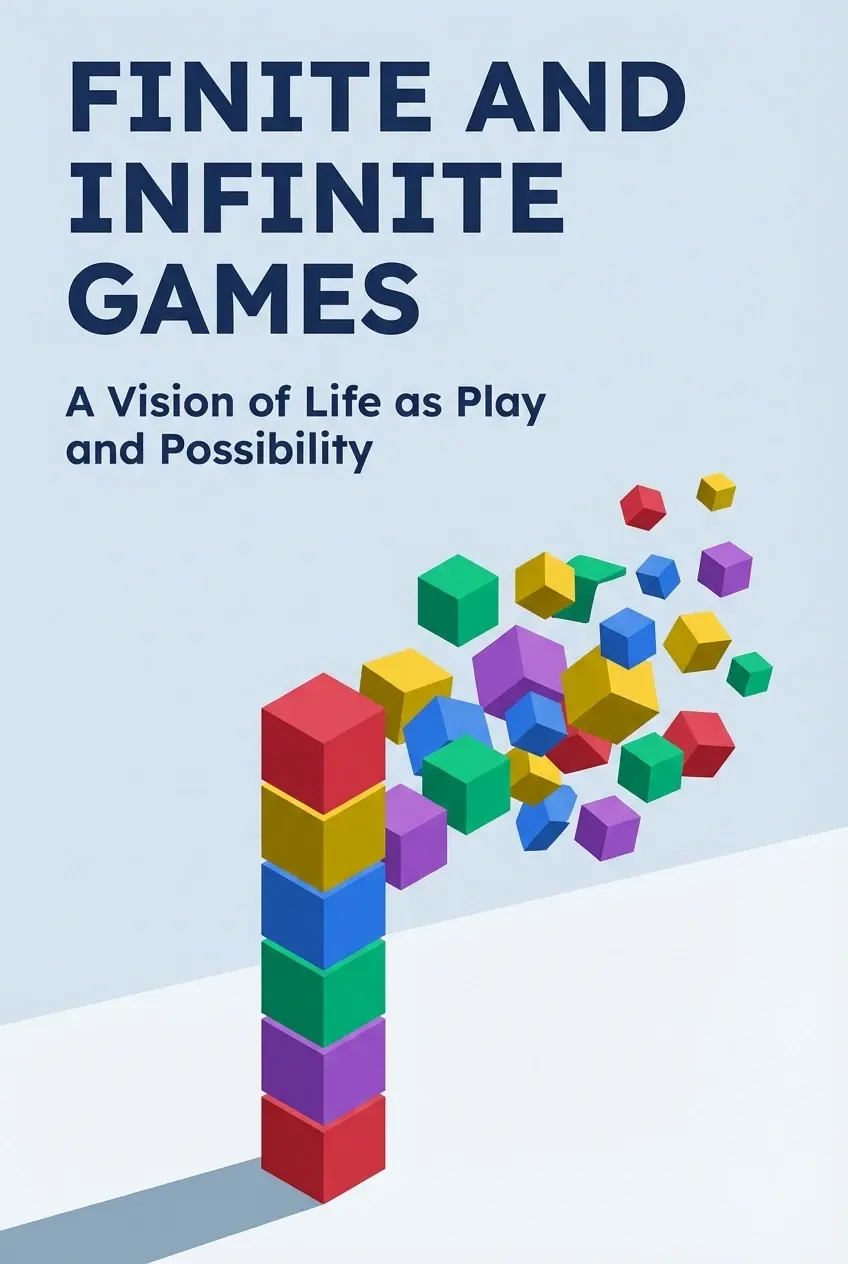
Book summary
by James Carse
Premium summary · Opens in the app · 5 min read
Finite and Infinite Games offers the theory that we play many different games in life, showing you that work and relationships are long-term endeavors and how to play them in order to win.
Finite and Infinite Games offers the theory that we play many different games in life, showing you that work and relationships are long-term endeavors and how to play them in order to win.
As suggested by the book’s title, Carse believes that games come in two fundamental types: finite and infinite. Finite games are those where it’s clear who the players are and who the audience is. Finite games also take place at clear places, spaces, and times, under set rules. The purpose of the game is to finish the game and agree upon a winner. Sports are clear examples of finite games.
Infinite games are less obvious and more complex: they have ever-changing sets of players and even rules. The goal of an infinite game is to keep on playing forever, rather than to stop by declaring a winner. Players in an infinite game are just trying to keep the authentic interactions rolling.
You might think of your job as a finite game. A job is about proving yourself to your boss and win titles and money. Your career is more like an infinite game. You can do anything within this game because it doesn’t have fixed rules. At the end of a career, you don’t win or lose, and your body of work can even live on in time after your death.
Both kinds of games are paradoxical, according to Carse. Finite games are played to be ended. After all, if a sports match doesn’t end with a winner, it usually means something has gone wrong. Infinite games, on the other hand, are paradoxical because the players want the game to be continued even by others.
Games don’t just happen in a vacuum. They have audiences who note what takes place, and whose memories can record information about winners and losers. Participants in a finite game are competing to prove that they’re not losers and to earn a more positive assessment of others. Titles in finite games, like sports champions, look to the past for information about who therefore holds power now. Remember, though, that forced play is no play at all! Players in a game may feel like they can’t quit. However, even as children, we learned that if a playmate packs up her toys to go home, the game is lost. You can try to convince someone to play a game but you can’t force them to play. If you feel like you can’t quit a game, it’s just because you’ve convinced yourself of that. What’s the implication here? If you’re playing a game that you don’t care about winning or whose rules you don’t like, you can stop at any time. There are lots of…
Continue reading in the MinuteRead app
Get the complete 5-minute summary of Finite and Infinite Games
Get the complete summary in the appGames with boundaries must end, but some playful activities can go on forever.
If you don’t care about winning in front of the audience, then you have no reason to play that game.
Games are all around us — and we should start playing them.
"Finite and Infinite Games" is a strong fit if you want practical ideas around business, career, communication skills, especially themes like games with boundaries must end, but some playful activities can go on forever; if you don’t care about winning in front of the audience, then you have no reason to play that game. The MinuteRead summary distills these concepts into a focused read, whether you're deciding whether to buy the book or applying its lessons at work.
Motivated to help readers with finite and Infinite Games offers the theory that we play many different games in life, James Carse wrote “Finite and Infinite Games” to package those ideas for a fast, focused read. In “Finite and Infinite Games”, James Carse focuses on finite and Infinite Games offers the theory that we play many different games in life. Through “Finite and Infinite Games”, James Carse distills the core ideas on business into lessons readers can absorb in a single short sitting. R…
View all summaries by James CarseContinue Reading
Access the complete 5-minute summary and thousands more nonfiction books in the MinuteRead app.

Continue reading the complete summary in the MinuteRead app.