MinuteRead
30 min
Most people do not think of themselves as economists. They think of economics as a technical subject filled with charts, equations, and jargon that belongs in universities and government agencies. But economics is not really about money. It is about how people cooperate with one another. It is about how strangers manage to feed, clothe, house, and heal each other without anyone directing them to do so. It is about the difference between societies that flourish and societies that collapse.
**Author:** Milton Friedman
**Estimated Reading Time:** 45 minutes
**What You'll Learn:**
- Why voluntary exchange creates prosperity while coercion destroys it - How government interventions often produce the opposite of their intended effects - Why inflation is always a government-created problem - How economic freedom underpins political liberty - What real education reform requires - Why the pursuit of equality of outcome leads to neither equality nor freedom
**Who This Book Is For:**
This book is for anyone who has wondered why well-intentioned government programs so often fail, why prices keep rising, why schools seem stuck, or how free societies maintain their freedom. It is for readers who want to understand the deep connection between economic arrangements and human flourishing. It is for the curious citizen, the skeptical taxpayer, the frustrated parent, and the student of how societies actually work.
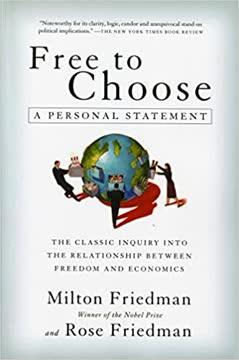
Most people do not think of themselves as economists. They think of economics as a technical subject filled with charts, equations, and jargon that belongs in universities and government agencies. But economics is not really about money. It is about how people cooperate with one another. It is about how strangers manage to feed, clothe, house, and heal each other without anyone directing them to do so. It is about the difference between societies that flourish and societies that collapse. Milton Friedman wrote *Free to Choose* with his wife and collaborator Rose Friedman to address a simple but profound question: How can millions of people, each pursuing their own interests, coordinate their activities without central direction? And what happens when governments try to improve on that spontaneous coordination? The book emerged from a television series of the same name that aired in 1980. Friedman, already a Nobel Prize-winning economist, wanted to reach beyond academia and speak directly to ordinary people about the ideas that shape their lives. He believed that economic literacy was not a luxury but a necessity for citizens of a free society. If people do not understand how markets work, they will not understand why some policies succeed and others fail. They will be vulnerable to promises that sound good but produce harm. The central problem the book addresses is the gap between intention and result. Governments around the world regularly pass laws and create programs designed to help people. They promise to protect workers, stabilize prices, improve education, and lift people out of poverty. Yet the results often fall far short of the promises. Sometimes the results are the exact opposite of what was intended. Friedman argues that this is not a coincidence. It is a predictable consequence of misunderstanding how economic systems actually work. Consider a simple example. A city government decides that housing costs…
Continue reading in the MinuteRead app
Get the complete 30-minute summary of Free to Choose
Get the complete summary in the appVoluntary exchange benefits both parties. Coercion benefits some at the expense of others.
Inflation is caused by government expanding the money supply faster than the economy grows.
Price controls create shortages. Wage controls create unemployment.
Competition is the most effective protection for consumers and workers.
Public schools fail because they face no competition. Vouchers would fix this.
Unions benefit their members at the expense of other workers.
"Free to Choose" is a strong fit if you want practical ideas around economics, politics, philosophy, especially themes like voluntary exchange benefits both parties. coercion benefits some at the expense of others; inflation is caused by government expanding the money supply faster than the economy grows. The MinuteRead summary distills these concepts into a focused read, whether you're deciding whether to buy the book or applying its lessons at work.
Milton Friedman was a Nobel Prize-winning economist and influential public intellectual. He made significant contributions to economics and statistics, particularly in consumption analysis and monetary theory. Friedman was a strong advocate for economic freedom and free market principles. His work had a major impact on economic policies and thinking in the latter half of the 20th century. Friedman's ideas challenged prevailing Keynesian economics and helped shape modern monetary policy. He was k…
View all summaries by Milton FriedmanContinue Reading
Access the complete 30-minute summary and thousands more nonfiction books in the MinuteRead app.

Continue reading the complete summary in the MinuteRead app.