MinuteRead
30 min
Book summary
by Harvard Business Publishing
Premium summary · Opens in the app · 30 min read
Every day, millions of business documents are written and ignored. Emails sit unopened. Proposals get skimmed and discarded. Reports are filed away without being read. The problem is not a lack of information. The problem is that most business writing fails to respect the reader's time, intelligence, and needs.
**Author:** Bryan A. Garner
**Estimated Reading Time:** 45 minutes
**What You'll Learn:**
- Why clear writing is a competitive advantage in business - How to structure proposals, emails, and reports that get results - The psychology of busy readers and how to write for them - Practical techniques to trim wordiness without losing substance - How to strike the right tone for any audience or situation
**Who This Book Is For:**
Professionals who write emails, proposals, reports, or memos and want their words to produce action. Whether you are an executive, manager, entrepreneur, or specialist, this guide will help you write with greater clarity, confidence, and impact.
Every day, millions of business documents are written and ignored. Emails sit unopened. Proposals get skimmed and discarded. Reports are filed away without being read. The problem is not a lack of information. The problem is that most business writing fails to respect the reader's time, intelligence, and needs. Bryan A. Garner has spent decades teaching lawyers, executives, and professionals how to write better. His central observation is simple: most people write to impress rather than to communicate. They use big words when small ones would do. They bury their main point under layers of background information. They write from their own perspective instead of considering what the reader actually needs to know. The result is predictable. Readers tune out. Decisions get delayed. Opportunities are lost. This book exists because the cost of poor writing is enormous. A confusing email can derail a project. A vague proposal can lose a contract. A poorly structured report can lead to bad decisions. Yet most professionals receive little or no training in how to write effectively. They are expected to figure it out on their own, and many never do. The good news is that better business writing is not a mystery. It is not a talent you are born with or without. It is a skill that can be learned, practiced, and mastered. Garner's approach is refreshingly practical. He does not ask you to memorize complex grammar rules or adopt a stiff, formal style. Instead, he shows you how to think clearly about your reader, organize your thoughts logically, and express yourself in plain, direct language. What makes this book different from other writing guides is its focus on the business context. Garner understands that business readers are not reading for pleasure. They are reading to solve problems, make decisions, and get things done. They are busy, impatient, and easily distracted. If you do not give them what they need quickly and clearly, they will move on. The book also recognizes that writing is not a single skill but a process. There is the creative…
Continue reading in the MinuteRead app
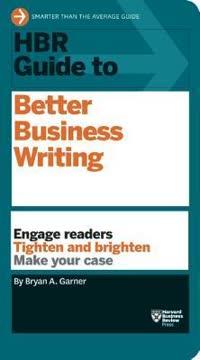
Get the complete 30-minute summary of HBR Guide to Better Business Writing
Get the complete summary in the appThink about your reader before you write. What do they need to know? What action do you want them to take?
Put your main point up front. Do not bury it under background information.
Write quickly, then edit systematically. These are separate processes.
Make your subject lines specific and action-oriented.
Cut unnecessary words. Every word must earn its place.
Focus on the client's needs, not your credentials.
"HBR Guide to Better Business Writing" is a strong fit if you want practical ideas around business, writing, communication, especially themes like think about your reader before you write. what do they need to know? what action do you want them to take?; put your main point up front. do not bury it under background information. The MinuteRead summary distills these concepts into a focused read, whether you're deciding whether to buy the book or applying its lessons at work.
Bryan A. Garner is a renowned expert in legal writing and English usage. He is the author of numerous books on writing and language, including the HBR Guide to Better Business Writing. Garner serves as Distinguished Research Professor of Law at Southern Methodist University and has been editor-in-chief of Black's Law Dictionary since 1995. He is known for his advocacy of plain language in legal and business writing, and has worked extensively to improve writing standards in various professional …
View all summaries by Harvard Business PublishingContinue Reading
Access the complete 30-minute summary and thousands more nonfiction books in the MinuteRead app.

Continue reading the complete summary in the MinuteRead app.