 MinuteRead
30 min
Book summary
by Harvard Business Publishing
Premium summary · Opens in the app · 30 min read
Every year, organizations around the world spend billions of dollars on change initiatives. They hire consultants, launch training programs, restructure divisions, rewrite mission statements, and deploy sophisticated communication campaigns. They hold town halls, create change management offices, and appoint transformation leaders. And yet, study after study confirms what most experienced managers already know in their bones: the vast majority of these efforts fail to deliver meaningful, lasting
**Author:** Harvard Business Publishing
**Estimated Reading Time:** 45 minutes
**What You'll Learn**
Why most organizational change efforts fail despite enormous investment of time, money, and executive attention. You will discover the fundamental misconceptions that undermine transformation programs, the critical distinction between structural change and behavioral change, and the practical frameworks that successful leaders use to drive lasting organizational renewal. You will learn why change must start at the periphery rather than the corporate center, how to balance hard economic imperatives with human organizational needs, and what it truly takes to embed new ways of working into the fabric of an organization.
**Who This Book Is For**
This book is for executives, managers, and change agents who have experienced the frustration of watching well-intentioned transformation initiatives stall or collapse. It is for leaders who suspect that the conventional playbook for organizational change is fundamentally flawed and want a deeper understanding of what actually works. It is for anyone responsible for guiding their organization through significant transition and who wants to avoid the costly mistakes that doom most change efforts.
Every year, organizations around the world spend billions of dollars on change initiatives. They hire consultants, launch training programs, restructure divisions, rewrite mission statements, and deploy sophisticated communication campaigns. They hold town halls, create change management offices, and appoint transformation leaders. And yet, study after study confirms what most experienced managers already know in their bones: the vast majority of these efforts fail to deliver meaningful, lasting change. The pattern is remarkably consistent. A company announces a major transformation. Senior leaders express unwavering commitment. Resources are allocated. Teams are formed. For a few months, there is visible activity: workshops, off-sites, new metrics, new language. Then, gradually, the energy dissipates. Old habits reassert themselves. The new processes are quietly abandoned. Within a year or two, the organization has largely reverted to its previous state, perhaps with some new vocabulary and a fresh set of PowerPoint slides to show for the effort. Why does this happen so reliably? Why do intelligent, well-intentioned leaders so consistently fail to transform their organizations? The answer, according to the research collected in this volume, is both simple and profoundly counterintuitive: most change programs are designed in ways that virtually guarantee their failure. The core problem is not a lack of effort or commitment. It is a fundamental misunderstanding of how organizational change actually works. Leaders tend to think of change as a program: something that can be designed, launched, and managed from the top. They believe that if they articulate a compelling vision, communicate it effectively, and align incentives appropriately, the organization will follow. They treat change as an engineering problem, solvable through analysis, planning, and execution. But…
Continue reading in the MinuteRead app
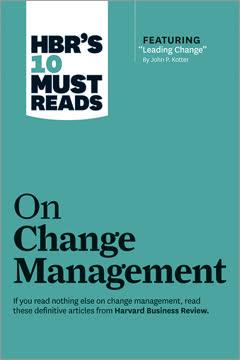
Get the complete 30-minute summary of HBR's 10 Must Reads on Change Management
Get the complete summary in the appChange is not a program; it is a process of learning and adaptation.
Start change at the periphery, where people are close to the work.
Focus on solving concrete business problems, not implementing abstract concepts.
Use task alignment to change behavior; culture will follow.
Follow the critical path: diagnose, envision, build, spread, institutionalize, monitor.
Balance Theory E and Theory O: deliver quick results while building long-term capability.
"HBR's 10 Must Reads on Change Management" is a strong fit if you want practical ideas around business, leadership, management, especially themes like change is not a program; it is a process of learning and adaptation; start change at the periphery, where people are close to the work. The MinuteRead summary distills these concepts into a focused read, whether you're deciding whether to buy the book or applying its lessons at work.
Harvard Business Review is a prestigious publication focused on management and business practices. It is produced by Harvard Business Publishing, a wholly-owned subsidiary of Harvard University. The Review publishes research and ideas from leading business thinkers, academics, and practitioners. Known for its rigorous editorial process, HBR has been influential in shaping management theory and practice since its founding in 1922. The Harvard Business Review team curates collections like this one…
View all summaries by Harvard Business PublishingContinue Reading
Access the complete 30-minute summary and thousands more nonfiction books in the MinuteRead app.

Continue reading the complete summary in the MinuteRead app.






