MinuteRead
30 min
Book summary
by Harvard Business Publishing
Premium summary · Opens in the app · 30 min read
Every day, in offices and boardrooms around the world, good ideas die quietly. They die in meetings where someone presents a thoughtful proposal but fails to connect with the people in the room. They die in emails that are technically accurate but emotionally tone-deaf. They die in conversations where the right words never arrive because the speaker did not understand who they were speaking to.
**Author:** Harvard Business Publishing
**Estimated Reading Time:** 90 minutes
**What You'll Learn:**
- Why persuasion is a collaborative process, not a battle of wills - How to build credibility that makes people want to listen - The five decision-maker types and how to communicate with each - How to use storytelling to inspire action and lead change - Practical techniques for navigating difficult conversations - How to craft authentic speeches that create genuine connection
**Who This Book Is For:**
This book is for anyone who has ever walked out of a meeting wishing they had spoken differently. It is for managers who need to align teams around a vision, leaders who must communicate change without triggering resistance, and professionals who want their ideas to gain traction. It is also for people who find certain conversations stressful and want a reliable framework for handling them with grace. If you have ever felt that your message was right but your delivery failed, this book will show you what to adjust.
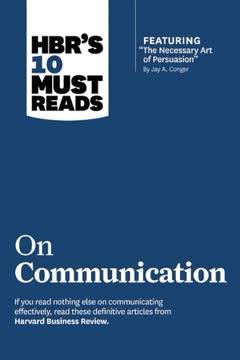
Every day, in offices and boardrooms around the world, good ideas die quietly. They die in meetings where someone presents a thoughtful proposal but fails to connect with the people in the room. They die in emails that are technically accurate but emotionally tone-deaf. They die in conversations where the right words never arrive because the speaker did not understand who they were speaking to. The strange thing is that most of these ideas deserved better. The problem was not the quality of the thinking. The problem was the quality of the communication. This is the central challenge that HBR's 10 Must Reads on Communication addresses. The book brings together some of the most influential articles Harvard Business Review has published on the art and science of communication. These are not theoretical musings from academics who have never sat in a tense meeting. They are practical, field-tested insights from people who have spent decades studying why some messages land and others bounce off. The book's premise is simple but profound: communication is not a soft skill. It is the mechanism through which everything else happens. Strategy cannot be executed without communication. Leadership cannot exist without communication. Trust cannot be built without communication. Change cannot happen without communication. Yet most people approach communication as if it were a natural talent you either have or you do not. They assume that some people are simply born persuasive, born articulate, born charismatic. This assumption is not just wrong. It is actively harmful because it prevents people from treating communication as a discipline that can be learned, practiced, and improved. The authors in this collection share a different view. They see communication as a set of…
Continue reading in the MinuteRead app
Get the complete 30-minute summary of HBR's 10 Must Reads on Communication
Get the complete summary in the appPersuasion is a collaborative process of learning and negotiating, not a one-sided pitch.
Credibility comes from expertise and relationships, and both must be built over time.
Start with your audience's goals, not your own. Find common ground before presenting your case.
Use stories, metaphors, and concrete examples to make your evidence vivid and memorable.
Connect emotionally with your audience. People make decisions based on emotion.
Adapt your communication style to different decision-maker types: charismatics, thinkers, skeptics, followers, and contr
"HBR's 10 Must Reads on Communication" is a strong fit if you want practical ideas around business, communication, leadership, especially themes like persuasion is a collaborative process of learning and negotiating, not a one-sided pitch; credibility comes from expertise and relationships, and both must be built over time. The MinuteRead summary distills these concepts into a focused read, whether you're deciding whether to buy the book or applying its lessons at work.
Harvard Business Review is a renowned business magazine published by Harvard Business Publishing, a subsidiary of Harvard University. It features articles on various aspects of management, leadership, and business strategy. The publication is known for its rigorous editorial process and contributions from leading academics, executives, and thought leaders. HBR's "Must Reads" series compiles essential articles on specific topics, providing readers with curated collections of influential business …
View all summaries by Harvard Business PublishingContinue Reading
Access the complete 30-minute summary and thousands more nonfiction books in the MinuteRead app.

Continue reading the complete summary in the MinuteRead app.