MinuteRead
30 min
Book summary
Premium summary · Opens in the app · 30 min read
The mythology of entrepreneurship is powerful. We have all heard the stories: the visionary founder toiling in a garage, the brilliant idea that changes everything, the meteoric rise from nothing to billions. These stories are compelling precisely because they are rare. They are the exceptions that prove a much more complicated rule.
**Author:** Harvard Business Review
**Estimated Reading Time:** 45 minutes
**What You'll Learn:**
- The real trade-offs founders face between wealth and control - How acquisition entrepreneurship offers a viable alternative to starting from scratch - Why lean startup methodology transformed how successful companies are built - How to navigate the inevitable leadership transitions as companies scale - What actually builds trust in online marketplaces - The systematic process for finding, evaluating, and buying an existing business
**Who This Book Is For:**
This book is for anyone who has ever considered building something of their own. It is for the founder wrestling with whether to raise venture capital or bootstrap. It is for the corporate executive dreaming of buying a small business and running it independently. It is for the product manager wondering if there is a better way to launch than writing a hundred-page business plan. It is for the investor trying to understand why some founders succeed while others flame out. And it is for anyone who wants to understand the real mechanics of entrepreneurship, stripped of mythology and grounded in evidence.
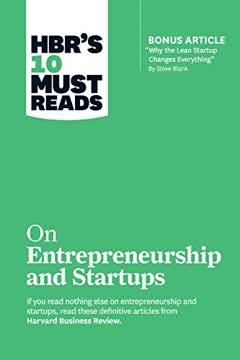
The mythology of entrepreneurship is powerful. We have all heard the stories: the visionary founder toiling in a garage, the brilliant idea that changes everything, the meteoric rise from nothing to billions. These stories are compelling precisely because they are rare. They are the exceptions that prove a much more complicated rule. The reality of entrepreneurship is far messier, far more interesting, and far more accessible than the mythology suggests. Most successful entrepreneurs do not start with a world-changing idea. Many do not start companies at all. They buy them. Many founders who do start companies discover that their greatest challenge is not the product but their own limitations as leaders. Many startups fail not because their ideas were bad but because they spent too much time planning and too little time learning. This collection brings together some of the most important thinking on entrepreneurship and startups from Harvard Business Review. The articles assembled here represent decades of research into what actually works, what actually fails, and what actually matters when building a business. The central insight running through this book is that entrepreneurship is not a single path but a landscape of choices. Every founder makes trade-offs. The most important trade-off is between wealth and control. Do you want to own a smaller piece of something big or a bigger piece of something small? Do you want to be the boss or do you want to be rich? These are not the same thing, and the tension between them shapes every decision a founder makes. Another theme is that entrepreneurship is increasingly a discipline that can…
Continue reading in the MinuteRead app
Get the complete 30-minute summary of HBR's 10 Must Reads on Entrepreneurship and Startups
Get the complete summary in the app**The wealth-control trade-off is universal.** Every entrepreneur faces it. Clarity about your own motivations is the ke
**Acquisition entrepreneurship is a viable path.** Buying an existing business is often better than starting from scratc
**The search requires full-time commitment.** It is not a part-time activity. Discipline is more important than enthusia
**Focus on enduring profitability.** Look for stable revenue, loyal customers, and strong market positions. Boring is go
**Cash flow is king.** Take control of cash flow immediately after acquiring a business.
**Founder skills have limits.** The skills that help you start a company are not the skills you need to scale it.
"HBR's 10 Must Reads on Entrepreneurship and Startups" is a strong fit if you want practical ideas around business, entrepreneurship, startup, especially themes like **the wealth-control trade-off is universal.** every entrepreneur faces it. clarity about your own motivations is the ke; **acquisition entrepreneurship is a viable path.** buying an existing business is often better than starting from scratc. The MinuteRead summary distills these concepts into a focused read, whether you're deciding whether to buy the book or applying its lessons at work.
Harvard Business Review is a prestigious publication known for its high-quality business content. As the author of this book, HBR has compiled a collection of articles from various experts in the field of entrepreneurship and startups. The Harvard Business Review is renowned for its ability to bring together thought leaders and practitioners to share insights and experiences. While individual authors contribute to the articles within the book, HBR's editorial team curates and presents the conten…
View all summaries by Harvard Business ReviewContinue Reading
Access the complete 30-minute summary and thousands more nonfiction books in the MinuteRead app.

Continue reading the complete summary in the MinuteRead app.