 MinuteRead
30 min
Book summary
by Harvard Business Publishing
Premium summary · Opens in the app · 30 min read
Every day, organizations make decisions that determine their future. Some of these decisions are small and easily reversed. Others are large, consequential, and irreversible. The quality of these decisions, more than any other factor, separates thriving companies from struggling ones.
**Author:** Harvard Business Publishing
**Estimated Reading Time:** 45 minutes
**What You'll Learn:**
- Why most strategic planning processes fail to produce better decisions - How to redesign planning so it actually drives strategy - The hidden traps that derail even experienced decision makers - How to balance data, analytics, and human judgment - Practical frameworks for making higher-quality decisions under uncertainty - How to build decision-making capability across your organization
**Who This Book Is For:**
This book is for executives, managers, entrepreneurs, and team leaders who want to improve the quality of their decisions. It is for anyone who has sat through endless planning meetings that produced little action. It is for leaders who suspect their organization's decision-making process is broken but cannot pinpoint why. And it is for professionals who want to move beyond gut feel and develop a disciplined, repeatable approach to making smart choices.
Every day, organizations make decisions that determine their future. Some of these decisions are small and easily reversed. Others are large, consequential, and irreversible. The quality of these decisions, more than any other factor, separates thriving companies from struggling ones. Yet most organizations approach decision making with surprisingly little discipline. They invest enormous resources in strategic planning, data collection, and analysis. They build sophisticated financial models. They hire brilliant people. And still, bad decisions happen with alarming regularity. Why? The answer, according to the research collected in this volume, is that most organizations confuse activity with effectiveness. They mistake the ritual of planning for the substance of deciding. They assume that more data leads to better choices. They believe that analytical models can substitute for judgment. And they fail to recognize the hidden psychological traps that distort their thinking. The result is a familiar pattern. Companies spend months preparing annual strategic plans that nobody uses. Executives make major commitments based on flawed assumptions. Teams fall into groupthink and suppress dissenting voices. Managers rely on models they do not fully understand. And when things go wrong, nobody can explain why a seemingly rational process produced such a poor outcome. This book addresses these failures directly. It brings together some of the most influential thinking on decision making from the Harvard Business Review. The authors represented here include leading scholars, consultants, and practitioners who have spent decades studying how decisions are made, why they go wrong, and what leaders can do to improve them. The central message is both simple and profound: decision making is a skill that can be learned, practiced, and improved. It is not a mysterious art reserved for the naturally gifted. It is a discipline with identifiable principles, common pitfalls, and proven techniques. The chapters that follow explore this discipline from…
Continue reading in the MinuteRead app
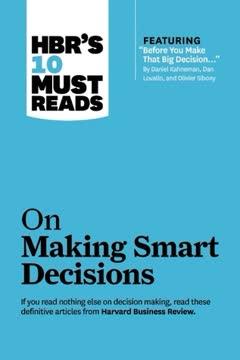
Get the complete 30-minute summary of HBR's 10 Must Reads on Making Smart Decisions
Get the complete summary in the appDecision making is a process that can be designed, managed, and improved.
Strategic planning often fails because it is disconnected from decision making.
Replace annual, unit-based planning with continuous, issues-focused planning.
Link planning and decision making: the goal of planning is decisions, not documents.
Focus strategy discussions on companywide issues that cut across unit boundaries.
Spread strategy reviews throughout the year rather than compressing them into a single season.
"HBR's 10 Must Reads on Making Smart Decisions" is a strong fit if you want practical ideas around business, leadership, management, especially themes like decision making is a process that can be designed, managed, and improved; strategic planning often fails because it is disconnected from decision making. The MinuteRead summary distills these concepts into a focused read, whether you're deciding whether to buy the book or applying its lessons at work.
Harvard Business Publishing (HBP) is a not-for-profit publisher affiliated with Harvard Business School, established in 1994. It focuses on improving business management practices through various media and learning formats. HBP offers articles, books, case studies, simulations, videos, and digital tools to organizations and subscribers. The company is divided into three market units: Education, Corporate Learning, and Harvard Business Review Group. Their products include print and digital media,…
View all summaries by Harvard Business PublishingContinue Reading
Access the complete 30-minute summary and thousands more nonfiction books in the MinuteRead app.

Continue reading the complete summary in the MinuteRead app.






