 MinuteRead
30 min
Book summary
by Harvard Business Publishing
Premium summary · Opens in the app · 30 min read
Managing people is often described as both the most rewarding and the most frustrating part of any leader's job. The technical skills that earn someone a promotion rarely prepare them for the messy, unpredictable, deeply human work of leading others. An engineer who excels at solving complex problems may find herself baffled by a team member who consistently misses deadlines despite having clear instructions. A brilliant strategist may watch his carefully crafted plans collapse because he failed
**Author:** Harvard Business Publishing
**Estimated Reading Time:** 90 minutes
**What You'll Learn:**
- Why the best leaders switch between multiple leadership styles rather than relying on one approach - How fair process transforms employee commitment and organizational performance - Why unconscious bias undermines even well-intentioned managers and how to counter it - The art of managing your boss and why it matters more than you think - How to build teams that genuinely outperform collections of talented individuals
**Who This Book Is For:**
Managers who want to move beyond intuition and develop a systematic understanding of what makes people perform at their best. Whether you are a first-time supervisor struggling with difficult conversations or a seasoned executive looking to sharpen your leadership instincts, this collection offers research-backed insights that translate directly into daily practice.
Managing people is often described as both the most rewarding and the most frustrating part of any leader's job. The technical skills that earn someone a promotion rarely prepare them for the messy, unpredictable, deeply human work of leading others. An engineer who excels at solving complex problems may find herself baffled by a team member who consistently misses deadlines despite having clear instructions. A brilliant strategist may watch his carefully crafted plans collapse because he failed to account for the emotional dynamics playing out among his direct reports. This gap between technical competence and managerial effectiveness has been the subject of decades of research at Harvard Business School and beyond. The findings consistently point to a truth that many organizations still struggle to accept: managing people is not a soft skill that some people naturally possess and others lack. It is a discipline with identifiable principles, learnable behaviors, and measurable outcomes. The essays collected in this volume represent some of the most influential thinking on people management published in the Harvard Business Review. They address questions that every leader eventually confronts. How do you motivate people who are already well compensated? What do you do when two talented employees cannot work together? How do you give feedback that actually changes behavior instead of triggering defensiveness? Why do some teams achieve extraordinary results while others, composed of equally talented individuals, consistently underperform? The answers to these questions are not always intuitive. In fact, much of what passes for conventional wisdom about management turns out to be incomplete or actively counterproductive. Consider the common belief that leaders should treat everyone the same way to avoid favoritism. Research suggests the opposite: the most effective managers tailor their approach to each individual, recognizing that different people need different kinds of support, challenge, and feedback to do their best work. Another persistent myth is that strong leadership means projecting unwavering…
Continue reading in the MinuteRead app
Get the complete 30-minute summary of HBR's 10 Must Reads on Managing People
Get the complete summary in the app**No single leadership style is best.** The most effective leaders master multiple styles and switch among them dependin
**Emotional intelligence is the foundation of leadership.** Self-awareness, self-management, social awareness, and relat
**A real team requires shared purpose, specific goals, complementary skills, and mutual accountability.** Calling a grou
**Fair process builds trust and commitment.** Engage people in decisions, explain your reasoning, and clarify expectatio
**Everyone has unconscious biases.** Build systems and practices that reduce their impact rather than trusting your judg
**Manage your boss deliberately.** Understand their goals, pressures, and working style, and adapt your approach accordi
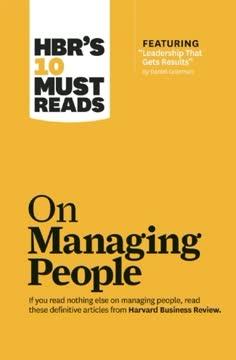
"HBR's 10 Must Reads on Managing People" is a strong fit if you want practical ideas around business, leadership, management, especially themes like **no single leadership style is best.** the most effective leaders master multiple styles and switch among them dependin; **emotional intelligence is the foundation of leadership.** self-awareness, self-management, social awareness, and relat. The MinuteRead summary distills these concepts into a focused read, whether you're deciding whether to buy the book or applying its lessons at work.
Dolly Chugh is an author and social psychologist known for her work on unconscious bias and ethical decision-making. She is a professor at New York University's Stern School of Business, where she teaches courses on leadership and diversity. Chugh's research focuses on the psychological processes that lead people to make unethical decisions without realizing it. She has published numerous articles in academic journals and popular media outlets, discussing topics such as implicit bias, diversity …
View all summaries by Harvard Business PublishingContinue Reading
Access the complete 30-minute summary and thousands more nonfiction books in the MinuteRead app.

Continue reading the complete summary in the MinuteRead app.






