MinuteRead
30 min
Book summary
Premium summary · Opens in the app · 30 min read
Most people believe they understand how an economy works. They know that spending creates jobs, that low interest rates help borrowers, that government stimulus can rescue a struggling economy, and that inflation is just a normal part of modern life. These ideas feel intuitive. They are repeated constantly by politicians, journalists, and even many economists. They form the background noise of financial news and political debate.
**Author:** Peter D. Schiff
**Estimated Reading Time:** 2 hours 15 minutes
**What You'll Learn:**
- Why savings, not spending, is the true engine of economic growth - How government intervention distorts the natural rhythms of markets - Why inflation silently destroys wealth and what it really is - How credit expansion creates the illusion of prosperity - What sound money means and why it matters more than you think - How to see through popular economic myths that dominate headlines
**Who This Book Is For:**
This book is for anyone who has ever wondered why economies boom and bust, why prices keep rising, why governments seem unable to stop crises, or why the financial advice you hear on television never quite adds up. It is for readers who want to understand economics not as a collection of abstract equations but as a living system driven by human choices, incentives, and consequences. Whether you are an investor, a student, a business owner, or simply someone who wants to make better sense of the world, this book will change how you see money, markets, and the policies that shape your life.
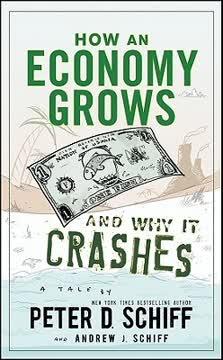
Most people believe they understand how an economy works. They know that spending creates jobs, that low interest rates help borrowers, that government stimulus can rescue a struggling economy, and that inflation is just a normal part of modern life. These ideas feel intuitive. They are repeated constantly by politicians, journalists, and even many economists. They form the background noise of financial news and political debate. But what if almost everything you have been told about how economies grow is wrong? Peter Schiff wrote *How an Economy Grows and Why It Crashes* to challenge the assumptions that dominate modern economic thinking. He does not do this with dense academic prose or complex mathematical models. Instead, he tells a story. It begins on a small island with three people, some fish, and a very simple problem: how to survive. From that humble starting point, Schiff builds an entire economic system, layer by layer, showing how savings, investment, trade, money, banking, and government all emerge naturally from human action. The genius of this approach is that it strips economics down to its essentials. Without the jargon and the statistics, the fundamental principles become clear. And once you see them, you cannot unsee them. You begin to notice that the policies celebrated in the news often violate the most basic rules of economic common sense. You start to understand why economies crash, why currencies lose value, and why debt-fueled booms always end badly. The central problem Schiff addresses is the disconnect between what people believe about economics and how economies actually work. This disconnect…
Continue reading in the MinuteRead app
Get the complete 30-minute summary of How an Economy Grows and Why It Crashes
Get the complete summary in the app**Savings drive growth.** An economy grows because people save and invest, not because they spend.
**Production is the source of wealth.** You cannot consume what has not been produced.
**Inflation is a hidden tax.** It transfers wealth from savers to debtors and destroys the value of money.
**Credit expansion creates booms and busts.** The boom feels like prosperity, but it is built on debt.
**Government intervention creates unintended consequences.** The road to economic ruin is paved with good intentions.
**Free markets work.** The price system is the most efficient mechanism for coordinating economic activity.
"How an Economy Grows and Why It Crashes" is a strong fit if you want practical ideas around economics, finance, business, especially themes like **savings drive growth.** an economy grows because people save and invest, not because they spend; **production is the source of wealth.** you cannot consume what has not been produced. The MinuteRead summary distills these concepts into a focused read, whether you're deciding whether to buy the book or applying its lessons at work.
Peter David Schiff is an American investment broker, author, and financial commentator. He is the CEO of Euro Pacific Capital Inc. and Euro Pacific Precious Metals, LLC. Schiff is known for his bearish views on the US dollar and dollar-denominated assets, while being bullish on tangible assets, foreign stocks, and currencies. He frequently appears on major financial news networks and hosts his own radio show, The Peter Schiff Show. Schiff's background includes a failed bid for the US Senate seat…
View all summaries by Peter D. SchiffContinue Reading
Access the complete 30-minute summary and thousands more nonfiction books in the MinuteRead app.

Continue reading the complete summary in the MinuteRead app.