 MinuteRead
30 min
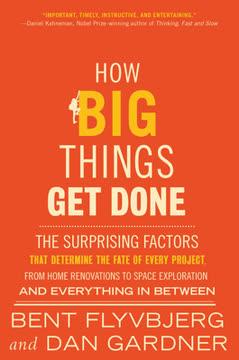
Book summary
Premium summary · Opens in the app · 30 min read
In 1910, the Empire State Building did not exist, but the ambition to build the world's tallest skyscraper was already taking shape in the minds of New York's most determined developers. Two decades later, when construction finally began, the project moved with astonishing speed. The building rose at a rate of four and a half stories per week. It was completed in just thirteen months, ahead of schedule and under budget. At the time, it was the tallest building ever constructed by human hands.
**Author:** Bent Flyvbjerg
**Estimated Reading Time:** 48 minutes
**What You'll Learn:**
- Why the conventional wisdom about big projects is dangerously wrong - The hidden psychology that causes project leaders to make costly mistakes - The proven planning method that separates spectacular successes from catastrophic failures - How modularity transforms impossible projects into manageable ones - The forecasting technique that eliminates costly optimism bias - How to build teams that actually deliver
**Who This Book Is For:**
Anyone who has ever been responsible for a project that matters. Whether you are launching a startup, renovating a home, leading a corporate transformation, or managing a public infrastructure initiative, the principles in this book apply directly to your work. If you have ever watched a project spiral out of control and wondered why, this book provides the answer.
In 1910, the Empire State Building did not exist, but the ambition to build the world's tallest skyscraper was already taking shape in the minds of New York's most determined developers. Two decades later, when construction finally began, the project moved with astonishing speed. The building rose at a rate of four and a half stories per week. It was completed in just thirteen months, ahead of schedule and under budget. At the time, it was the tallest building ever constructed by human hands. Now consider the Sydney Opera House. Construction began in 1959 with an estimated completion date of 1963 and a budget of seven million Australian dollars. It was finally finished in 1973, ten years late and more than fourteen times over budget. The architect, Jørn Utzon, never saw his masterpiece completed. He resigned in frustration and left Australia, never to return. What explains the difference between these two projects? Both were ambitious. Both were unprecedented in their own ways. Both captured the imagination of the public. Yet one became a model of efficiency while the other became a cautionary tale studied for generations. Bent Flyvbjerg has spent his career answering this question. As a professor at Oxford University and the world's leading expert on megaproject management, he has compiled a database of more than sixteen thousand projects across 136 countries. The database includes bridges, tunnels, dams, power plants, airports, hospitals, museums, IT systems, and Olympic Games. What he discovered is both disturbing and liberating. The disturbing part is this: most big projects fail. They go over budget, fall behind schedule, or fail to deliver the benefits they promised. This is not an occasional problem. It is the norm. Flyvbjerg's research shows that only about 0.5 percent of projects hit all three targets of budget, schedule, and benefits. That means 99.5 percent of projects fail in at least one critical dimension. The…
Continue reading in the MinuteRead app
Get the complete 30-minute summary of How Big Things Get Done
Get the complete summary in the app**Think slow, act fast.** Invest heavily in planning, then move quickly during execution.
**Projects start wrong, not go wrong.** The seeds of failure are planted in the commitments made before anyone fully und
**Start with why.** Define the outcome you want to achieve before deciding how to achieve it.
**Avoid the commitment fallacy.** Commit to goals, not to specific approaches. Explore alternatives before committing.
**Iterate during planning.** Use models, simulations, and prototypes to test ideas cheaply before committing to executio
**Leverage experience.** Hire experienced people and use proven methods. Learn from past projects.
"How Big Things Get Done" is a strong fit if you want practical ideas around business, management, leadership, especially themes like **think slow, act fast.** invest heavily in planning, then move quickly during execution; **projects start wrong, not go wrong.** the seeds of failure are planted in the commitments made before anyone fully und. The MinuteRead summary distills these concepts into a focused read, whether you're deciding whether to buy the book or applying its lessons at work.
Bent Flyvbjerg is a renowned expert in megaproject management and planning. As a professor at Oxford University, he has built a database of over 16,000 projects across 136 countries, establishing himself as a leading authority in the field. Flyvbjerg's work focuses on understanding why large-scale projects often fail and identifying strategies for success. His research combines empirical analysis with practical insights, making his findings relevant to both academic and professional audiences. F…
View all summaries by Bent FlyvbjergContinue Reading
Access the complete 30-minute summary and thousands more nonfiction books in the MinuteRead app.

Continue reading the complete summary in the MinuteRead app.






