MinuteRead
30 min
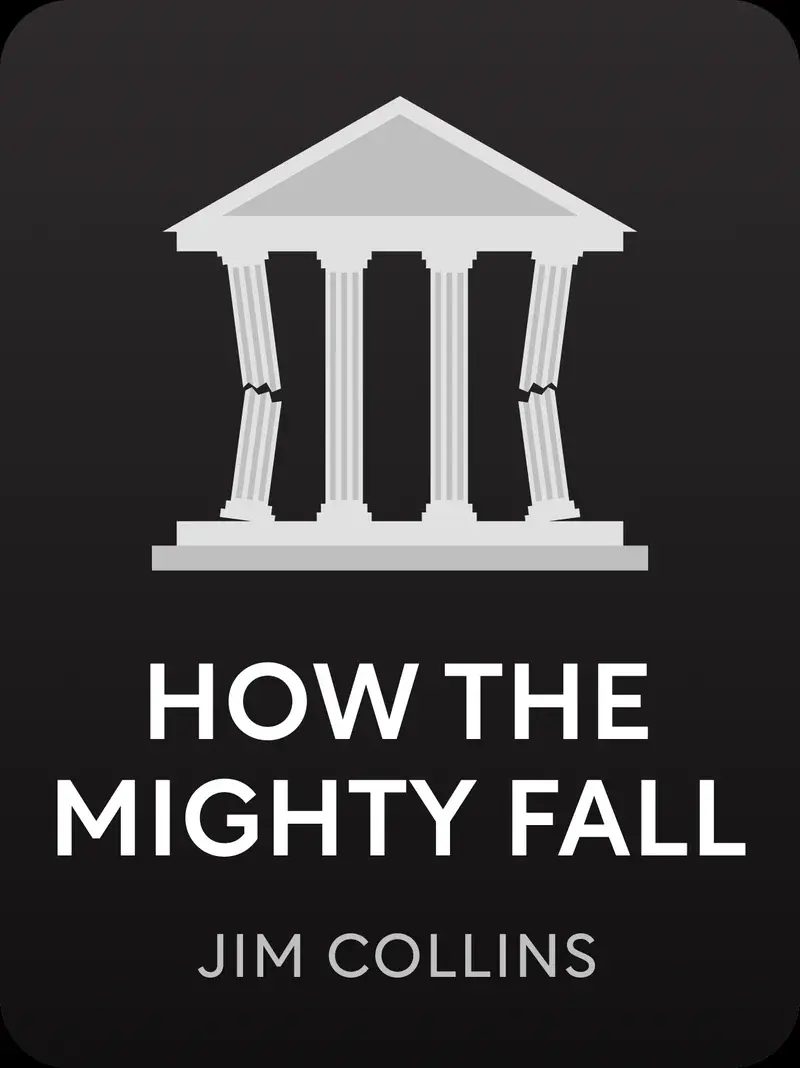
Book summary
by Jim Collins
Premium summary · Opens in the app · 30 min read
Every great institution eventually faces a moment when the ground begins to shift beneath it. The question is not whether challenges will come. The question is whether the organization will recognize the danger in time to do something about it.
**Author:** Jim Collins
**Estimated Reading Time:** 45 minutes
**What You'll Learn:** Why once-great companies collapse, the five predictable stages of decline, how to recognize the warning signs early, and what leaders can do to reverse the slide before it becomes terminal.
**Who This Book Is For:** Leaders, executives, entrepreneurs, investors, and anyone who wants to understand why success is fragile and how to build organizations that endure.
Every great institution eventually faces a moment when the ground begins to shift beneath it. The question is not whether challenges will come. The question is whether the organization will recognize the danger in time to do something about it. Jim Collins spent years studying companies that made the leap from good to great. His earlier work examined what separates exceptional organizations from merely competent ones. But as he watched the business landscape in the years following those studies, something troubling caught his attention. Some of the very companies he had celebrated as exemplars of greatness began to stumble. Some fell hard. This observation sparked a new investigation. Collins and his research team wanted to understand how mighty companies fall. They studied organizations that had once been dominant, companies that had enjoyed decades of success, and traced their paths downward. What they discovered was both sobering and hopeful. The sobering part is that decline follows a predictable pattern. It does not happen randomly. It does not strike without warning. Companies move through five distinct stages, each one making the next more likely. The hopeful part is that decline is largely self-inflicted. If organizations can recognize the early warning signs, they can interrupt the pattern before it becomes irreversible. The problem is that most leaders do not see decline coming. They are too close to the situation. They are surrounded by people who tell them what they want to hear. They interpret ambiguous data in the most favorable light. They believe their past success guarantees future performance. Collins calls this the "silent creep of doom." It begins quietly, almost imperceptibly. A company that was once hungry becomes satisfied. A culture that once valued rigorous debate becomes polite and complacent. Leaders who once confronted brutal facts begin to explain them away. By the time the crisis becomes obvious to everyone, the options have narrowed dramatically. What makes this book different from typical business failure literature is its refusal to accept inevitability. Collins does not argue that great companies are doomed to fall. He argues that decline is a choice, or more precisely, a series of choices. Organizations that fall do so because they make predictable mistakes at predictable moments. Organizations that endure do so because they maintain the disciplines that made them great in the…
Continue reading in the MinuteRead app
Get the complete 30-minute summary of How The Mighty Fall
Get the complete summary in the appDecline follows five predictable stages: hubris, overreaching, denial, grasping, and capitulation.
Success breeds hubris. Stay humble or prepare to fall.
Growth without discipline destroys value. Respect Packard's Law.
Denial is the most dangerous stage. Confront brutal facts early.
Silver bullets do not exist. Recovery requires patient, disciplined work.
Cash is king. Profitability does not guarantee survival.
"How The Mighty Fall" is a strong fit if you want practical ideas around business, leadership, management, especially themes like decline follows five predictable stages: hubris, overreaching, denial, grasping, and capitulation; success breeds hubris. stay humble or prepare to fall. The MinuteRead summary distills these concepts into a focused read, whether you're deciding whether to buy the book or applying its lessons at work.
James C. Collins is a renowned business researcher and author known for his studies on enduring great companies. He has written several bestselling books, including "Built to Last" and "Good to Great," which have been translated into numerous languages. Collins began his career as a faculty member at Stanford Graduate School of Business before founding a management laboratory in Colorado. He has taught executives from various sectors and holds degrees from Stanford University. Besides his academ…
View all summaries by Jim CollinsContinue Reading
Access the complete 30-minute summary and thousands more nonfiction books in the MinuteRead app.

Continue reading the complete summary in the MinuteRead app.