 MinuteRead
30 min
Book summary
Premium summary · Opens in the app · 30 min read
Every day, millions of people walk into offices, factories, hospitals, schools, and startups. They attend meetings, answer emails, navigate relationships with colleagues, and try to accomplish goals that require coordination with others. Most of them rarely stop to ask a fundamental question: what exactly is this thing I am part of?
**Author:** Gareth Morgan
**Estimated Reading Time:** 45 minutes
**What You'll Learn:**
- Why every organization can be understood through multiple powerful metaphors - How machines, organisms, brains, cultures, political systems, and psychic prisons each reveal different truths about organizational life - Practical frameworks for diagnosing organizational problems and designing better solutions - How to become a more flexible, creative, and effective leader by expanding your mental toolkit
**Who This Book Is For:**
Managers, leaders, entrepreneurs, consultants, students of organizational behavior, and anyone who has ever wondered why organizations behave the way they do. If you have ever felt trapped by a dysfunctional workplace, puzzled by office politics, or frustrated by change initiatives that fail, this book will give you new eyes.
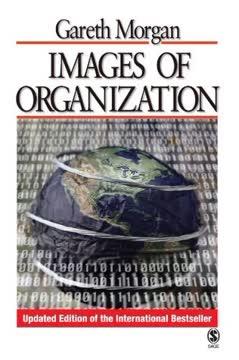
Every day, millions of people walk into offices, factories, hospitals, schools, and startups. They attend meetings, answer emails, navigate relationships with colleagues, and try to accomplish goals that require coordination with others. Most of them rarely stop to ask a fundamental question: what exactly is this thing I am part of? We tend to take organizations for granted. We assume they are simply collections of people working toward common objectives, governed by rules and hierarchies. We assume that if we could just find the right structure, the right strategy, or the right leader, everything would work smoothly. Yet despite decades of management advice, countless reorganizations, and endless leadership training programs, organizations remain stubbornly difficult to understand and even harder to change. Gareth Morgan's Images of Organization offers a radically different approach. Instead of searching for the one correct way to understand organizations, Morgan argues that we should embrace multiple ways of seeing. His central insight is deceptively simple: all theories of organization are based on metaphors. When we say an organization is like a machine, or like an organism, or like a brain, we are not just using poetic language. We are making a fundamental choice about how we understand reality, and that choice shapes everything we see and do. The problem is that most of us become trapped in one dominant metaphor without realizing it. We inherit a way of seeing organizations from our education, our culture, or our early work experiences, and we mistake that partial view for the whole truth. A manager who sees the organization as a machine will focus on efficiency, standardization, and control. A manager who sees it as a political system will focus on power, alliances, and negotiation. Both are seeing something real, but neither is seeing everything. Morgan's book is an invitation to expand your vision. He presents a series of powerful metaphors, each of which illuminates different aspects of organizational life. The machine metaphor reveals the importance of structure and…
Continue reading in the MinuteRead app
Get the complete 30-minute summary of Images of Organization
Get the complete summary in the appEvery theory of organization is based on a metaphor, and each metaphor reveals some truths while hiding others.
The machine metaphor emphasizes efficiency and control but becomes problematic when flexibility and engagement are neede
The organism metaphor reminds us that organizations must adapt to their environments, but they can also shape those envi
The brain metaphor shows that intelligence can be distributed throughout an organization through learning loops and loca
The culture metaphor reveals that organizations are systems of shared meaning, not just structures and processes.
The political metaphor exposes the power dynamics and competing interests that shape organizational decisions.
"Images of Organization" is a strong fit if you want practical ideas around business, management, leadership, especially themes like every theory of organization is based on a metaphor, and each metaphor reveals some truths while hiding others; the machine metaphor emphasizes efficiency and control but becomes problematic when flexibility and engagement are neede. The MinuteRead summary distills these concepts into a focused read, whether you're deciding whether to buy the book or applying its lessons at work.
Gareth Morgan is a renowned organizational theorist and author best known for his work on metaphors in organizational analysis. His book "Images of Organization" has become a seminal text in the field of management and organizational studies. Morgan's approach involves using metaphors to understand and analyze complex organizational structures and behaviors. He has contributed significantly to the development of organizational theory and has influenced how managers and scholars think about organ…
View all summaries by Gareth MorganContinue Reading
Access the complete 30-minute summary and thousands more nonfiction books in the MinuteRead app.

Continue reading the complete summary in the MinuteRead app.






