 MinuteRead
30 min
Book summary
Premium summary · Opens in the app · 30 min read
Every organization has a formal structure. It appears on charts with neat boxes and solid lines. It defines who reports to whom, who approves budgets, who assigns work, and who conducts performance reviews. For most of your career, you have probably been told that this structure is how things get done. If you need something from another department, you go through channels. If you need resources, you ask your manager. If you need cooperation, you invoke the hierarchy.
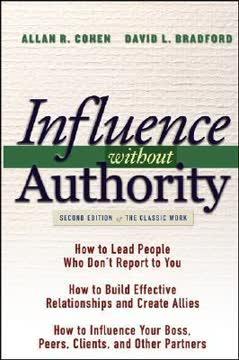
**Author:** Allan R. Cohen (with David L. Bradford)
**Estimated Reading Time:** 45 minutes
**What You'll Learn:** How to get things done when you lack formal power, the art of exchange and reciprocity, how to identify what others truly value, and how to build the relationships that make influence possible.
**Who This Book Is For:** Professionals who must collaborate across teams, project managers without direct authority, individual contributors who need resources from others, and anyone who has ever felt stuck because they could not simply tell people what to do.
Every organization has a formal structure. It appears on charts with neat boxes and solid lines. It defines who reports to whom, who approves budgets, who assigns work, and who conducts performance reviews. For most of your career, you have probably been told that this structure is how things get done. If you need something from another department, you go through channels. If you need resources, you ask your manager. If you need cooperation, you invoke the hierarchy. Then reality intervenes. The colleague whose help you need does not report to you. The manager whose approval you require has different priorities. The team you depend on is overwhelmed with its own work. The executive who could clear the path is unreachable. You have no authority over any of them, yet your success depends entirely on their cooperation. This is the fundamental challenge of modern organizational life. Work has become more interconnected, more project-based, more matrixed, and more collaborative. The days when a single manager could command all the resources needed for a task are largely gone. Today, almost everyone must influence people over whom they have no formal control. The ability to do this well is not a nice-to-have skill. It is the difference between career advancement and stagnation, between successful projects and frustrating failures, between feeling empowered and feeling helpless. Allan Cohen and David Bradford spent decades studying this challenge. They taught at Babson College and consulted with organizations across industries. They watched talented professionals struggle not because they lacked technical skills or good ideas, but because they could not get others to support them. They also watched less technically gifted individuals succeed because they understood something important about how human beings actually work together. That something is the law of reciprocity. Human beings operate on a deeply ingrained principle of exchange. When someone does something for us, we feel an obligation to do something for them. This is not a cynical observation about manipulation. It is a fundamental truth about human relationships. It is the glue that holds societies together. It is how trust forms, how cooperation emerges, and how influence spreads. The problem is that most people never…
Continue reading in the MinuteRead app
Get the complete 30-minute summary of Influence Without Authority
Get the complete summary in the appInfluence without authority is possible because human relationships operate on exchange and reciprocity.
Assume everyone is a potential ally. Your assumptions shape their responses.
Currencies are anything another person values. You have more currencies to offer than you realize.
Diagnose the other person's world before making your approach. Understand their pressures, priorities, and values.
Clarify your own goals. Know what you want and what you are willing to trade.
Build relationships before you need them. Trust multiplies the value of your currencies.
"Influence Without Authority" is a strong fit if you want practical ideas around business, leadership, management, especially themes like influence without authority is possible because human relationships operate on exchange and reciprocity; assume everyone is a potential ally. your assumptions shape their responses. The MinuteRead summary distills these concepts into a focused read, whether you're deciding whether to buy the book or applying its lessons at work.
Allan R. Cohen is a distinguished professor and consultant specializing in organizational behavior and leadership. He co-authored "Influence Without Authority" with David L. Bradford, drawing on their extensive experience in academia and business consulting. Cohen has taught at Babson College and has a background in organizational psychology. His work focuses on helping individuals navigate complex workplace dynamics and achieve results without formal authority. Cohen's approach emphasizes under…
View all summaries by Allan R. CohenContinue Reading
Access the complete 30-minute summary and thousands more nonfiction books in the MinuteRead app.

Continue reading the complete summary in the MinuteRead app.






