MinuteRead
30 min
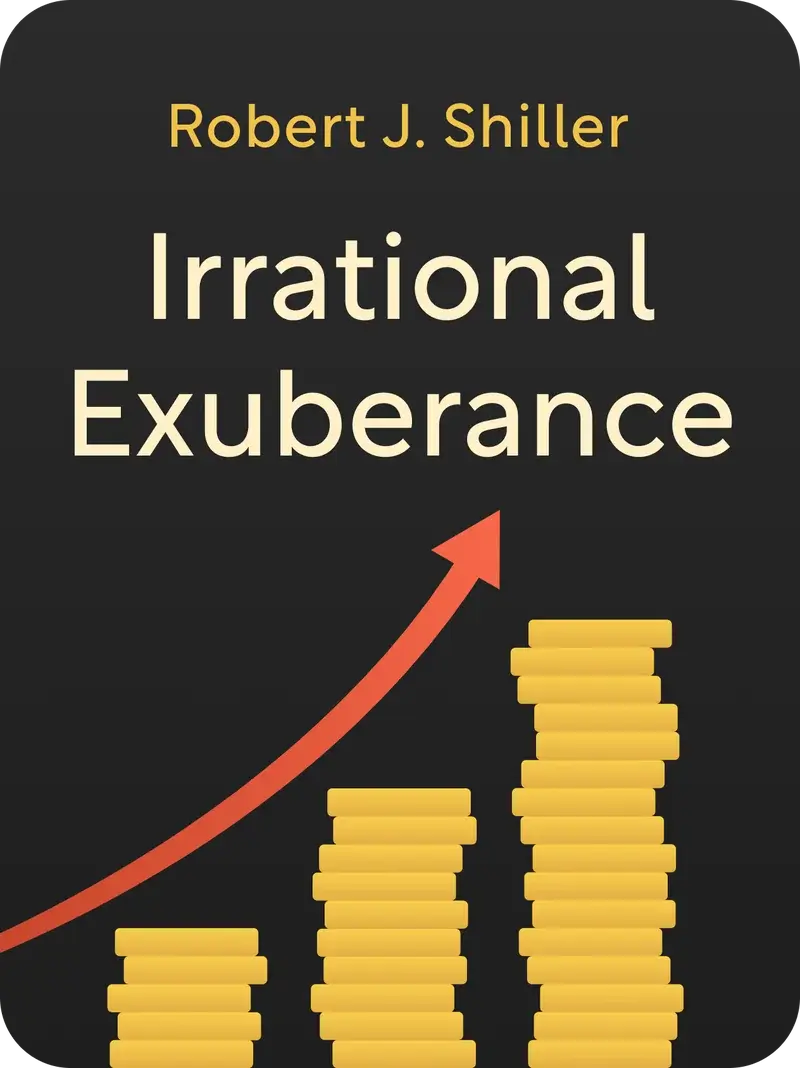
Book summary
Premium summary · Opens in the app · 30 min read
In the late 1990s, something strange happened in the American stock market. The Dow Jones Industrial Average crossed 10,000 for the first time in history. Then it crossed 11,000. Technology stocks with no earnings and barely any revenue were valued at billions of dollars. A company called Pets.com, which sold pet supplies online at a loss, raised $82 million in an initial public offering and was worth $300 million within months. Its business model involved shipping bags of dog food across the co
**Author:** Robert J. Shiller
**Estimated Reading Time:** 45 minutes
**What You'll Learn:**
* Why financial markets repeatedly produce spectacular booms and devastating busts * How psychological forces, not rational calculation, drive market behavior * Why "new era" thinking appears in every speculative bubble across centuries * What structural and cultural factors amplify irrational exuberance * How to recognize bubble conditions and protect yourself from their consequences
**Who This Book Is For:**
This book is for investors, policymakers, students of economics, and anyone who wants to understand why markets behave the way they do. It is for people who have watched stock prices soar and wondered whether they should buy, watched housing prices climb and wondered whether they should sell, and felt the pull of excitement when everyone around them seems to be getting rich. It is for readers who suspect that something deeper than supply and demand drives financial markets, and who want a clear-eyed explanation of what that something is.
In the late 1990s, something strange happened in the American stock market. The Dow Jones Industrial Average crossed 10,000 for the first time in history. Then it crossed 11,000. Technology stocks with no earnings and barely any revenue were valued at billions of dollars. A company called Pets.com, which sold pet supplies online at a loss, raised $82 million in an initial public offering and was worth $300 million within months. Its business model involved shipping bags of dog food across the country at prices that could never cover the cost of shipping. Robert Shiller watched this unfold with growing alarm. He was not a market forecaster or a Wall Street strategist. He was an economist at Yale University who had spent decades studying how markets actually behave, not how economic theory says they should behave. What he saw in the late 1990s looked eerily familiar. It looked like 1929. It looked like the South Sea Bubble of 1720. It looked like every speculative mania that had ever gripped a population. The term "irrational exuberance" came from Alan Greenspan, then chairman of the Federal Reserve, who used it in a speech in December 1996. Greenspan asked a simple question: "How do we know when irrational exuberance has unduly escalated asset values?" The question was rhetorical, but it identified something real. Markets were not simply reflecting economic fundamentals. They were reflecting something else, something psychological, something contagious. Shiller's book, first published in 2000, attempted to answer Greenspan's question. The book argued that stock prices had become detached from any reasonable measure of value, and that the forces driving them upward were psychological and social, not economic. The book was published in March 2000, almost exactly at the peak of the…
Continue reading in the MinuteRead app
Get the complete 30-minute summary of Irrational Exuberance
Get the complete summary in the appSpeculative bubbles are driven by a feedback loop between rising prices and investor enthusiasm.
Every bubble is accompanied by a narrative that this time is different.
The narrative is always built on real developments, which makes it compelling.
The media amplifies market movements and spreads enthusiasm.
Psychological anchors and social dynamics shape investor behavior.
Markets are not always efficient, and bubbles are common.
"Irrational Exuberance" is a strong fit if you want practical ideas around economics, finance, business, especially themes like speculative bubbles are driven by a feedback loop between rising prices and investor enthusiasm; every bubble is accompanied by a narrative that this time is different. The MinuteRead summary distills these concepts into a focused read, whether you're deciding whether to buy the book or applying its lessons at work.
Robert James Shiller is an American economist and professor at Yale University. He has made significant contributions to the field of behavioral finance and is known for his work on market volatility and asset bubbles. Shiller co-developed the Case-Shiller home price index and has written extensively on economic topics. He received the Nobel Prize in Economics in 2013 for his empirical analysis of asset prices. Shiller's research challenges traditional economic theories and emphasizes the role o…
View all summaries by Robert J. ShillerContinue Reading
Access the complete 30-minute summary and thousands more nonfiction books in the MinuteRead app.

Continue reading the complete summary in the MinuteRead app.