MinuteRead
30 min
Book summary
Premium summary · Opens in the app · 30 min read
Most books about leadership begin with a seductive promise. They suggest that with the right techniques, the right vision, and the right communication skills, you can inspire people to follow you toward a better future. They imply that leadership, while challenging, is fundamentally rewarding and that people will eventually appreciate your efforts.
**Author:** Ronald A. Heifetz
**Estimated Reading Time:** 45 minutes
**What You'll Learn:** Why leadership is inherently dangerous, how to recognize the resistance your efforts will provoke, and practical strategies for staying alive and effective while leading difficult change.
**Who This Book Is For:** Anyone who has tried to challenge the status quo, raise difficult questions, or mobilize people to confront hard truths, whether in business, politics, community life, or family relationships.
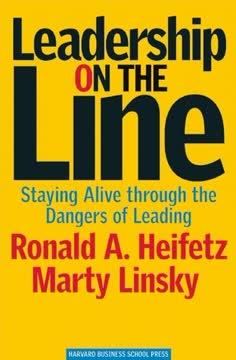
Most books about leadership begin with a seductive promise. They suggest that with the right techniques, the right vision, and the right communication skills, you can inspire people to follow you toward a better future. They imply that leadership, while challenging, is fundamentally rewarding and that people will eventually appreciate your efforts. Ronald Heifetz tells a different story. His book begins with a warning. Leadership is dangerous. Not dangerous in the sense of physical risk, though that can sometimes be part of the picture. Dangerous in the sense that when you genuinely lead, you threaten people. You threaten their sense of identity, their comfortable habits, their established values, and their familiar ways of making sense of the world. And when people feel threatened, they fight back. The central insight of this book is uncomfortable but essential: you appear dangerous to people when you question their values, beliefs, or habits of a lifetime. This is not a flaw in your leadership. It is not something you can avoid with better communication or more empathy. It is a structural feature of what leadership actually is. The problem is that most of the challenges that matter, the ones that keep organizations stuck, communities divided, and individuals trapped, are not technical problems with clear solutions. They are adaptive challenges. They require people to change their priorities, abandon cherished assumptions, and accept losses. And people do not willingly accept loss. They resist, deflect, and sometimes attack. Heifetz spent decades teaching at Harvard's Kennedy School and advising leaders in government, business, and civil society. What he observed repeatedly is that the people who take on the hardest challenges often become the targets of the very communities they are trying to help. They get marginalized, dismissed, attacked, or seduced into silence. Not because they are bad leaders, but because they are effective ones. This book is about how to survive that reality. It is about understanding the dangers of leadership so you can anticipate them, recognize them when they appear, and respond strategically rather than reactively. It is about developing the capacity to stay engaged with people who are angry at you, to hold steady when the pressure mounts, and to maintain your sense of purpose when the work feels thankless. The approach Heifetz offers is…
Continue reading in the MinuteRead app
Get the complete 30-minute summary of Leadership on the Line
Get the complete summary in the appLeadership is dangerous because it requires people to confront loss.
Resistance takes four forms: marginalization, diversion, attack, and seduction.
Get on the balcony to see the larger patterns and distinguish technical from adaptive challenges.
Think politically: find partners, keep the opposition close, and move the uncommitted.
Orchestrate conflict by creating a holding environment and controlling the temperature.
Give the work back to the people who need to do it.
"Leadership on the Line" is a strong fit if you want practical ideas around leadership, business, management, especially themes like leadership is dangerous because it requires people to confront loss; resistance takes four forms: marginalization, diversion, attack, and seduction. The MinuteRead summary distills these concepts into a focused read, whether you're deciding whether to buy the book or applying its lessons at work.
Ronald A. Heifetz is a renowned leadership expert and educator. He is the founding director of the Center for Public Leadership at Harvard Kennedy School, where he has taught for over three decades. Heifetz is known for developing the adaptive leadership framework, which emphasizes the importance of mobilizing people to tackle tough challenges and thrive. His research focuses on how leaders can build capacity to address complex systemic problems. Heifetz has authored several influential books on…
View all summaries by Ronald A. HeifetzContinue Reading
Access the complete 30-minute summary and thousands more nonfiction books in the MinuteRead app.

Continue reading the complete summary in the MinuteRead app.