 MinuteRead
30 min
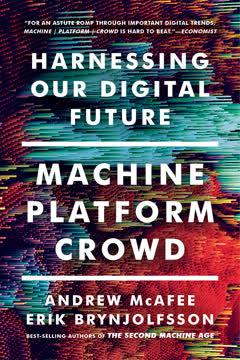
Book summary
Premium summary · Opens in the app · 30 min read
Every few decades, a set of technologies arrives that fundamentally changes how business works. The steam engine did it. Electricity did it. The internet did it. And now, according to Andrew McAfee and Erik Brynjolfsson, we are living through another such moment.
**Author:** Andrew McAfee and Erik Brynjolfsson
**Estimated Reading Time:** 45 minutes
**What You'll Learn:**
How artificial intelligence is changing decision-making, why digital platforms are disrupting traditional businesses, and what happens when companies learn to harness the collective intelligence of the crowd. You will understand the three great rebalancings happening in business today and how to position yourself and your organization to thrive amid them.
**Who This Book Is For:**
Business leaders trying to navigate digital transformation, entrepreneurs building platform-based ventures, managers wondering how AI will affect their teams, and anyone curious about how technology is reshaping the economy and society.
Every few decades, a set of technologies arrives that fundamentally changes how business works. The steam engine did it. Electricity did it. The internet did it. And now, according to Andrew McAfee and Erik Brynjolfsson, we are living through another such moment. The authors of Machine, Platform, Crowd spent years studying how digital technologies transform companies, industries, and entire economies. Their previous work explored how automation was changing the workforce. This book goes deeper. It asks a more fundamental question: what happens to business when machines start making better decisions than humans, when platforms start beating products, and when the crowd starts outperforming the core? Most business books focus on one of these shifts. Some books tell you about artificial intelligence. Others explain the rise of platforms like Uber and Airbnb. Still others explore crowdsourcing and open innovation. What makes this book different is that McAfee and Brynjolfsson see these as three parts of the same story. The story begins with a simple observation. For most of human history, the best way to make a decision was to find a smart, experienced person and ask them. Doctors diagnosed illnesses. Financial analysts picked stocks. Managers made hiring calls. Expertise lived in human minds, and those minds were scarce and expensive. Then something changed. Computers got fast enough and data got abundant enough that machines started beating human experts at their own games. Not everywhere, not yet, but in a growing number of domains. And the machines keep getting better. At the same time, the economics of business shifted. For most of the industrial era, the path to success was building a great product and protecting it. Companies invested in factories, supply chains, and brands. But digital platforms changed the rules. A platform doesn't make the product. It connects people who have something with people who want something. And once a platform reaches critical mass, it becomes extraordinarily difficult to compete with. Finally, the boundary between what a company does internally and what it gets from outside has blurred. The "core" of a company used to be its employees, its proprietary knowledge,…
Continue reading in the MinuteRead app
Get the complete 30-minute summary of Machine, Platform, Crowd
Get the complete summary in the appMachine learning is transforming decision-making by processing vast amounts of data and avoiding human biases.
The standard partnership combines human creativity and empathy with machine processing power and consistency.
Digital goods are free, perfect, and instant, making them extraordinarily difficult to compete with.
Platforms create value by connecting users, not by owning assets.
Network effects create winner-take-all dynamics that protect incumbents.
The crowd can do work that was once the exclusive domain of the core.
"Machine, Platform, Crowd" is a strong fit if you want practical ideas around business, technology, science, especially themes like machine learning is transforming decision-making by processing vast amounts of data and avoiding human biases; the standard partnership combines human creativity and empathy with machine processing power and consistency. The MinuteRead summary distills these concepts into a focused read, whether you're deciding whether to buy the book or applying its lessons at work.
Andrew McAfee and Erik Brynjolfsson are renowned experts in the field of information technology's impact on business, economics, and society. They are both affiliated with the MIT Sloan School of Management, where they conduct research and teach. McAfee and Brynjolfsson have co-authored several influential books on digital transformation, including "The Second Machine Age" and "Race Against the Machine." Their work focuses on how emerging technologies like artificial intelligence, digital platfo…
View all summaries by Andrew McAfeeContinue Reading
Access the complete 30-minute summary and thousands more nonfiction books in the MinuteRead app.

Continue reading the complete summary in the MinuteRead app.






