 MinuteRead
30 min
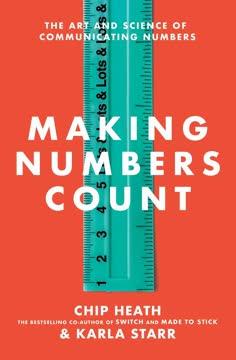
Book summary
by Chip Heath
Premium summary · Opens in the app · 30 min read
A few years ago, the United States government released a statistic that should have stopped the nation in its tracks. The number was $5.7 trillion. That was the projected cost of a major policy initiative, and it represented a staggering sum of money, enough to reshape the economy for a generation.
**Author:** Chip Heath
**Estimated Reading Time:** 42 minutes
**What You'll Learn:**
- Why almost everyone misunderstands numbers, even when they think they don't - How to translate abstract statistics into vivid, memorable comparisons - The art of making data feel human, emotional, and actionable - Specific techniques used by master communicators to make numbers stick - How to apply these skills in presentations, writing, and everyday conversations
**Who This Book Is For:**
Anyone who has ever presented a budget, shared a statistic, pitched an idea, taught a lesson, or tried to convince someone with data. If you work with numbers in any capacity, this book will change how you communicate forever.
A few years ago, the United States government released a statistic that should have stopped the nation in its tracks. The number was $5.7 trillion. That was the projected cost of a major policy initiative, and it represented a staggering sum of money, enough to reshape the economy for a generation. The problem was that almost nobody could feel what $5.7 trillion meant. Politicians debated it. Newspapers printed it. Analysts argued over it. But for the average person, $5.7 trillion was just a big number, vaguely understood as "a lot" but not meaningfully different from $2 trillion or $10 trillion. The number failed to communicate because numbers, by themselves, rarely communicate anything at all. Chip Heath has spent his career studying why some ideas stick and others vanish. In his work as a professor at Stanford's Graduate School of Business, he has watched brilliant people present important data to smart audiences, only to see the message fail to land. The problem is not that people are bad at math. The problem is that human brains are not built to understand numbers. Consider this: if I tell you that the distance from New York to Los Angeles is 2,789 miles, you understand it intellectually. But if I tell you that driving that distance at 60 miles per hour would take you more than 46 hours of nonstop driving, you feel it. The first version is a number. The second version is an experience. This book is about the art of translation. It is about taking the raw material of statistics, figures, and data, and converting it into something that human minds can actually grasp. The techniques in these pages are not complicated. They do not require advanced mathematical training. They require something far more valuable: an understanding of how people think. The challenge is urgent because numbers have never been more central to our lives. We are bombarded with statistics about health risks, economic trends, climate change, political polling, and personal finance. We make decisions based on these numbers, or…
Continue reading in the MinuteRead app
Get the complete 30-minute summary of Making Numbers Count
Get the complete summary in the appNobody really understands numbers. Your job is to translate them.
Use familiar comparisons. Connect abstract measurements to things your audience already knows.
Scale large numbers to human proportions. Time, money, and distance are powerful scaling units.
Tap into emotion. Numbers become memorable when they connect to things people care about.
Simplify ruthlessly. One clear message beats a dozen confusing statistics.
Engage the senses. Create experiences that make numbers tangible.
"Making Numbers Count" is a strong fit if you want practical ideas around business, science, communication, especially themes like nobody really understands numbers. your job is to translate them; use familiar comparisons. connect abstract measurements to things your audience already knows. The MinuteRead summary distills these concepts into a focused read, whether you're deciding whether to buy the book or applying its lessons at work.
Chip Heath is a professor of Organizational Behavior at Stanford University's Graduate School of Business. He holds a B.S. in Industrial Engineering from Texas A&M University and a Ph.D. in Psychology from Stanford. Heath is known for co-authoring books with his brother Dan Heath, including the popular "Switch: How to Change Things When Change Is Hard." His work focuses on organizational behavior, decision-making, and change management. Heath's academic background and research expertise inform h…
View all summaries by Chip HeathContinue Reading
Access the complete 30-minute summary and thousands more nonfiction books in the MinuteRead app.

Continue reading the complete summary in the MinuteRead app.






