 MinuteRead
30 min
Book summary
Premium summary · Opens in the app · 30 min read
Every organization on earth shares one common element. It does not matter whether the organization builds automobiles, treats patients, educates children, or collects taxes. It does not matter whether it employs five people or fifty thousand. Every single organization depends on management to function.
**Author:** Peter F. Drucker
**Estimated Reading Time:** 45 minutes
**What You'll Learn:** - Why management is the defining organ of every organization - How to create customers through marketing and innovation - What knowledge workers need from modern managers - How to set objectives that produce real results - Why social responsibility belongs at the center of management
**Who This Book Is For:** This book is for anyone who leads people, allocates resources, or bears responsibility for results. Whether you manage a small team, run a corporation, lead a nonprofit, or direct a government agency, the principles here apply to you. Drucker wrote for practitioners, not theorists. His ideas speak to the daily reality of making organizations work.
Every organization on earth shares one common element. It does not matter whether the organization builds automobiles, treats patients, educates children, or collects taxes. It does not matter whether it employs five people or fifty thousand. Every single organization depends on management to function. This sounds obvious today. It was not obvious when Peter Drucker began writing about management in the 1940s. At that time, management was not considered a discipline worthy of serious study. It was something people did, not something people thought about. Business schools taught accounting and economics. They did not teach management as a coherent practice with its own principles, tools, and responsibilities. Drucker changed that. Over a career spanning more than six decades, he developed a body of work that transformed management from an informal activity into a disciplined practice. He argued that management is not a collection of techniques but a distinct function with its own logic. He showed that the rise of large organizations in the twentieth century created a new social reality. These organizations, businesses, hospitals, universities, government agencies, could not succeed without skilled managers who understood their role. The problem Drucker identified is simple but profound. Most people who become managers receive no real preparation for the job. They are promoted because they performed well as individual contributors. Suddenly they must plan, organize, motivate, measure, and develop others. They must make decisions with incomplete information. They must balance competing demands from employees, customers, shareholders, and the public. They must think about the long term while delivering results today. None of this comes naturally. Management is not an innate talent. It is a practice that must be learned, refined, and adapted over time. Drucker's great contribution was to make that practice visible and teachable. He identified the fundamental tasks of management. He explained how to set objectives. He described how to organize work. He showed why innovation matters. He anticipated the rise of knowledge workers decades before the term became common. What makes Drucker's…
Continue reading in the MinuteRead app
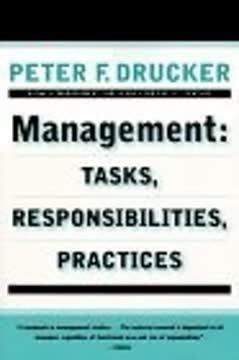
Get the complete 30-minute summary of Management, Revised Edition
Get the complete summary in the appManagement is the practice of making human resources productive. It applies to every organization.
The purpose of a business is to create a customer. Profit is a result, not a goal.
Only marketing and innovation produce results. Everything else is a cost.
Knowledge workers own the means of production. Manage them as partners, not subordinates.
Set clear objectives and give people the freedom to achieve them. Focus on results, not activities.
Managers must balance multiple responsibilities: results, people, strategy, operations, and stakeholders.
"Management, Revised Edition" is a strong fit if you want practical ideas around business, management, leadership, especially themes like management is the practice of making human resources productive. it applies to every organization; the purpose of a business is to create a customer. profit is a result, not a goal. The MinuteRead summary distills these concepts into a focused read, whether you're deciding whether to buy the book or applying its lessons at work.
Peter Ferdinand Drucker was an influential writer, management consultant, and university professor. Born in Austria in 1909, he moved to Germany before fleeing Nazi rule and settling in the United States. Drucker became a naturalized U.S. citizen in 1943. He taught management at New York University and Claremont Graduate University, establishing himself as a leading business thinker. Drucker is credited with coining the term "knowledge worker" and shaping modern management theory. His numerous b…
View all summaries by Peter F. DruckerContinue Reading
Access the complete 30-minute summary and thousands more nonfiction books in the MinuteRead app.

Continue reading the complete summary in the MinuteRead app.






