 MinuteRead
30 min
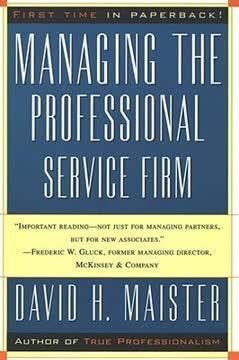
Book summary
Premium summary · Opens in the app · 30 min read
Professional service firms are peculiar institutions. They are businesses, but they do not behave like ordinary businesses. They are collections of highly intelligent, highly trained individuals, yet they often struggle with basic management questions that a modest manufacturing company would solve without difficulty. They generate substantial revenues, yet many of them fail to build lasting value. They attract some of the brightest minds in society, yet those minds frequently resist being manag
**Author:** David H. Maister
**Estimated Reading Time:** 45 minutes
**What You'll Learn:**
* Why technical excellence alone never guarantees client loyalty * How the three core goals of a professional firm interact and conflict * What separates thriving firms from those that merely survive * How leverage, productivity, and margins determine profitability * Why partner compensation drives behavior more powerfully than any memo * How to build a firm culture that attracts and retains exceptional talent * What strategic planning should actually look like in a professional practice
**Who This Book Is For:**
This book is for anyone who leads, manages, or aspires to lead a professional service firm. Whether you are a managing partner at a law firm, a practice leader at a consulting company, a senior architect running a design studio, or a partner at an accounting practice, the principles here apply directly to your daily reality. It is also for young professionals who want to understand how their firms actually work, why certain decisions get made, and what it takes to advance. If you have ever wondered why brilliant professionals sometimes run mediocre businesses, this book will answer that question with clarity and precision.
Professional service firms are peculiar institutions. They are businesses, but they do not behave like ordinary businesses. They are collections of highly intelligent, highly trained individuals, yet they often struggle with basic management questions that a modest manufacturing company would solve without difficulty. They generate substantial revenues, yet many of them fail to build lasting value. They attract some of the brightest minds in society, yet those minds frequently resist being managed at all. David Maister spent decades studying this strange world. He worked with law firms, consulting practices, accounting firms, engineering companies, and advertising agencies across the globe. What he found was remarkably consistent. The firms that succeeded over the long term were not necessarily the ones with the smartest people or the most prestigious clients. They were the ones that understood something deeper about how professional work actually functions. The central problem is that professional firms must serve three masters simultaneously. They must deliver outstanding service to clients. They must provide fulfilling careers for their people. And they must achieve financial success so they can reward themselves and grow. These three goals are not naturally aligned. In fact, they often pull in opposite directions. A firm that chases short-term profits may burn out its people and alienate its clients. A firm that obsesses over client satisfaction may underinvest in developing its junior staff. A firm that prioritizes employee happiness may find itself unable to compete on price or invest in new capabilities. Most professional firms fail to recognize this tension explicitly.…
Continue reading in the MinuteRead app
Get the complete 30-minute summary of Managing The Professional Service Firm
Get the complete summary in the appBalance the three goals: client service, employee satisfaction, and financial success. Neglecting any one eventually und
Service quality matters as much as technical quality. Clients judge you on responsiveness, communication, and empathy, n
Your people are your most important asset. Invest in attracting, developing, and retaining talent.
Compensation systems shape behavior. Design them deliberately to reward the behaviors your firm needs.
Leverage drives profitability, but it must be matched to the nature of the work. Not all work can be leveraged.
The one-firm approach creates advantages through collaboration and trust. Build a culture that encourages teamwork.
"Managing The Professional Service Firm" is a strong fit if you want practical ideas around business, management, leadership, especially themes like balance the three goals: client service, employee satisfaction, and financial success. neglecting any one eventually und; service quality matters as much as technical quality. clients judge you on responsiveness, communication, and empathy, n. The MinuteRead summary distills these concepts into a focused read, whether you're deciding whether to buy the book or applying its lessons at work.
David H. Maister is a renowned expert in professional services management. As a former Harvard Business School professor, David H. Maister has authored numerous influential books and articles on professional service firm management. He has consulted for many top firms worldwide, gaining extensive experience in areas such as strategy, marketing, and organizational development. Maister's work is known for its practical, research-based approach to improving firm performance and client relationships…
View all summaries by David H. MaisterContinue Reading
Access the complete 30-minute summary and thousands more nonfiction books in the MinuteRead app.

Continue reading the complete summary in the MinuteRead app.






