MinuteRead
30 min
Book summary
Premium summary · Opens in the app · 30 min read
Every year, thousands of bright, ambitious people step into the world of doctoral research. They arrive with excellent grades, genuine curiosity, and a deep desire to contribute something meaningful to their field. Yet a surprising number of them struggle not because they lack intelligence or dedication, but because nobody taught them how to navigate the peculiar, often unspoken rules of academic life.
**Author:** Patricia A. Gosling
**Estimated Reading Time:** 45 minutes
**What You'll Learn:** - How to choose the right research group and supervisor - Practical strategies for managing time and setting goals - How to design rigorous experiments and think like a scientist - Ways to communicate your research with clarity and confidence - How to navigate setbacks and build resilience - What it takes to write, defend, and move beyond your thesis
**Who This Book Is For:** This book is for anyone embarking on or currently navigating the long, demanding, and often bewildering journey of a doctoral degree. It is for the new PhD student standing at the threshold of an unfamiliar lab, the mid-degree researcher wrestling with failed experiments and shifting timelines, and the final-year candidate staring at a blank thesis document. It is also for supervisors who want to better understand the experience of their students, and for anyone considering whether a PhD is the right path.
Every year, thousands of bright, ambitious people step into the world of doctoral research. They arrive with excellent grades, genuine curiosity, and a deep desire to contribute something meaningful to their field. Yet a surprising number of them struggle not because they lack intelligence or dedication, but because nobody taught them how to navigate the peculiar, often unspoken rules of academic life. A PhD is unlike any other educational experience. It is not a series of courses to complete or exams to pass. It is an apprenticeship in the craft of research, conducted within a social structure that has its own hierarchies, customs, and pressures. You are expected to produce original work, manage your own time, collaborate with others, communicate your findings, and somehow maintain your sanity while doing all of it. The stakes feel high because they are high. Your thesis will be scrutinized by experts. Your publications will shape your reputation. Your relationship with your supervisor will influence your daily experience for years. The problem is that most PhD students receive little formal training in the skills that actually determine success. They learn laboratory techniques and statistical methods, but they are rarely taught how to choose a research group, how to set meaningful goals, how to handle conflict with a supervisor, or how to recover from a failed experiment that cost six months of work. These skills are assumed to develop naturally, but they often do not. Instead, students flounder, doubt themselves, and sometimes leave academia altogether, not because they lacked talent, but because they lacked guidance. Patricia Gosling wrote *Mastering Your PhD* to fill that gap. Her approach is grounded in a simple but powerful observation: a PhD is not just an intellectual challenge. It is a human…
Continue reading in the MinuteRead app
Get the complete 30-minute summary of Mastering Your PhD
Get the complete summary in the appChoose your research group based on fit, not prestige.
Use the Monthly Progress Monitor to plan and reflect every month.
Prioritize high-impact tasks using the 80/20 rule.
Design experiments that can truly discriminate between hypotheses.
Communicate your research clearly and persuasively.
Interpret setbacks as information, not judgment.
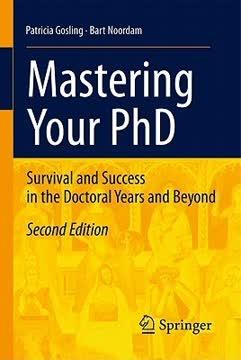
"Mastering Your PhD" is a strong fit if you want practical ideas around research, education, academics, especially themes like choose your research group based on fit, not prestige; use the monthly progress monitor to plan and reflect every month. The MinuteRead summary distills these concepts into a focused read, whether you're deciding whether to buy the book or applying its lessons at work.
Patricia Gosling is an author and academic expert known for her work on guiding PhD students through their academic journeys. Her book, "Mastering Your PhD," demonstrates her deep understanding of the challenges and nuances of doctoral studies. Patricia Gosling 's writing style is praised for being practical and accessible, offering concrete advice and strategies for success in academia. Her approach combines theoretical knowledge with real-world examples, making her work valuable for both new a…
View all summaries by Patricia A. GoslingContinue Reading
Access the complete 30-minute summary and thousands more nonfiction books in the MinuteRead app.

Continue reading the complete summary in the MinuteRead app.