MinuteRead
30 min
Book summary
Premium summary · Opens in the app · 30 min read
Every day, leaders make decisions that affect the lives of others. Some of these decisions are monumental: whether to lay off workers, how to respond to a product safety concern, when to blow the whistle on misconduct. Most are smaller: how to allocate a limited budget, what tone to set in a meeting, which employee to promote, how much information to share with a team. Yet each decision carries ethical weight.
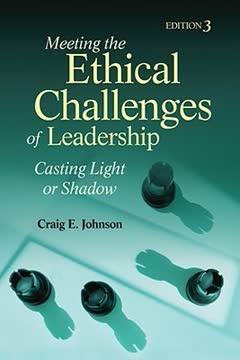
**Author:** Craig E. Johnson
**Estimated Reading Time:** 45 minutes
**What You'll Learn:**
- Why ethical leadership is not optional but foundational - How leaders cast light or shadows through everyday decisions - The six shadows that undermine even well-intentioned leaders - How to build moral character over a lifetime - Practical frameworks for ethical decision-making - How to create organizational cultures where ethics thrives
**Who This Book Is For:**
This book is for anyone who holds influence over others. Whether you lead a multinational corporation, a small team, a classroom, a family, or a community organization, the ethical challenges of leadership will find you. It is especially valuable for new managers stepping into formal authority for the first time, seasoned executives wrestling with complex moral dilemmas, educators shaping the next generation of leaders, and anyone who has ever wondered whether they are using their influence wisely.
Every day, leaders make decisions that affect the lives of others. Some of these decisions are monumental: whether to lay off workers, how to respond to a product safety concern, when to blow the whistle on misconduct. Most are smaller: how to allocate a limited budget, what tone to set in a meeting, which employee to promote, how much information to share with a team. Yet each decision carries ethical weight. Craig E. Johnson wrote *Meeting the Ethical Challenges of Leadership* because he recognized a troubling gap in how we prepare people for leadership. We spend enormous energy teaching strategy, finance, marketing, and operations. We teach people how to motivate teams, manage conflict, and communicate vision. But we spend remarkably little time helping leaders understand the moral dimensions of their work. The result is predictable: leaders who are technically skilled but ethically underprepared. The consequences of this gap are everywhere. Corporate scandals destroy livelihoods and erode public trust. Toxic leaders poison organizational cultures, driving away talented employees and crushing innovation. Political leaders abuse power, manipulate information, and serve narrow interests at the expense of the common good. Even well-meaning leaders cause harm because they fail to recognize the ethical implications of their choices. Johnson's central insight is both simple and profound: leadership is inherently an ethical activity. When you influence others, you take on moral responsibility for how that influence affects them. You cannot opt out of ethics. The only question is whether you will engage with this responsibility thoughtfully or stumble through it blindly. What makes Johnson's approach distinctive is his refusal to reduce ethics to a set of rules or a list of forbidden behaviors. Instead, he treats ethical leadership as a developmental journey. It involves building character, sharpening moral perception, learning to reason through complex dilemmas, and creating environments where others…
Continue reading in the MinuteRead app
Get the complete 30-minute summary of Meeting the Ethical Challenges of Leadership
Get the complete summary in the appLeadership and ethics are inseparable. You cannot lead well without leading ethically.
Every leader casts shadows. Self-awareness is the first defense against causing unintended harm.
Character is built through practice, not inherited. Cultivate virtues deliberately.
The capacity for evil exists in everyone. Humility and vigilance are essential.
Forgiveness breaks cycles of harm. It is a strength, not a weakness.
Ethical decisions require both emotion and reason. Integrate both.
"Meeting the Ethical Challenges of Leadership" is a strong fit if you want practical ideas around leadership, education, textbooks, especially themes like leadership and ethics are inseparable. you cannot lead well without leading ethically; every leader casts shadows. self-awareness is the first defense against causing unintended harm. The MinuteRead summary distills these concepts into a focused read, whether you're deciding whether to buy the book or applying its lessons at work.
Craig E. Johnson is an emeritus professor at George Fox University in Oregon, USA. He is a distinguished figure in the field of leadership ethics and has authored multiple editions of "Meeting the Ethical Challenges of Leadership." Johnson's work focuses on the ethical dimensions of leadership, emphasizing the moral responsibilities that come with leadership positions. His interdisciplinary approach combines insights from various fields to explore ethical decision-making, the influence of leader…
View all summaries by Craig E. JohnsonContinue Reading
Access the complete 30-minute summary and thousands more nonfiction books in the MinuteRead app.

Continue reading the complete summary in the MinuteRead app.