 MinuteRead
30 min
Book summary
by Carol Tavris
Premium summary · Opens in the app · 5 min read
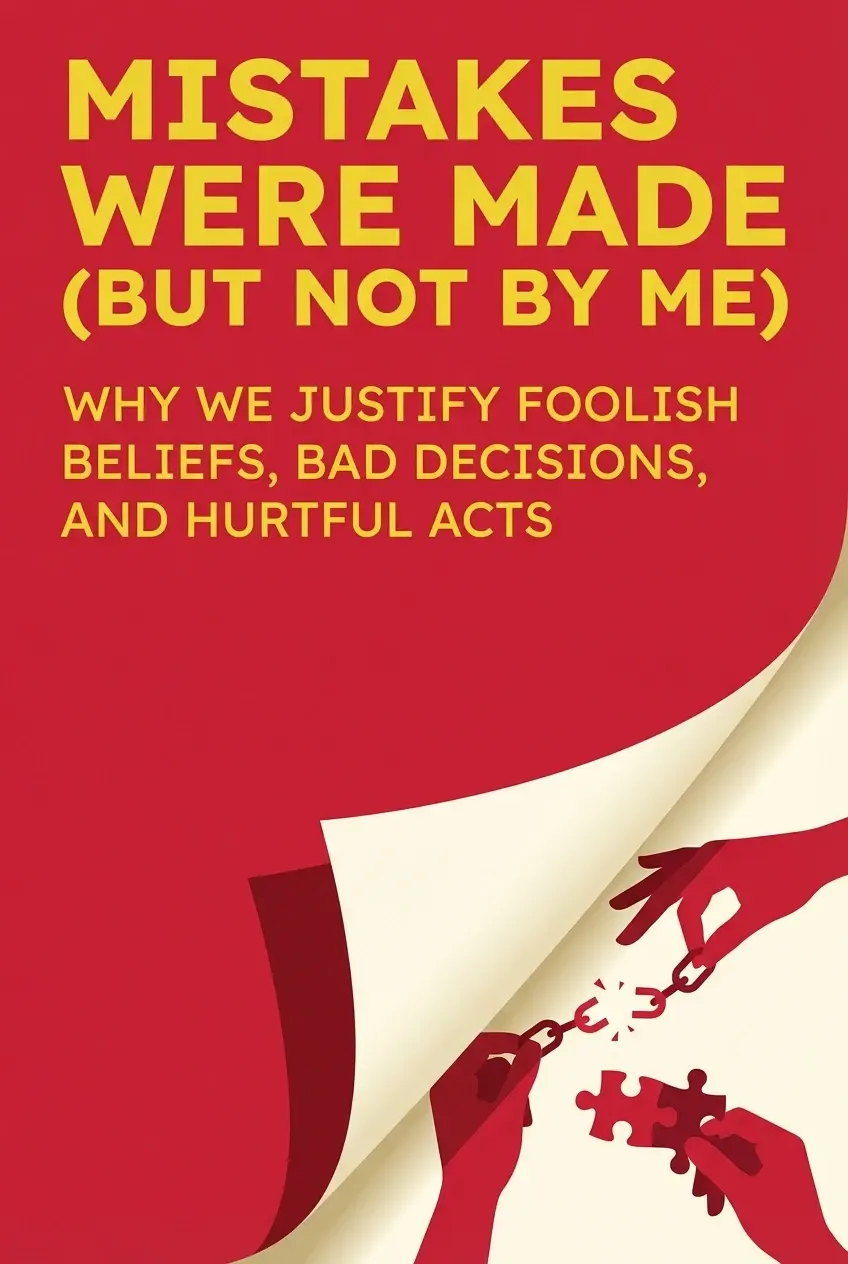
Mistakes Were Made, But Not By Me takes you on a journey of famous examples and areas of life where mistakes are hushed up instead of admitted, showing you along the way how this hinders progress, why we do it in the first place, and what you can do to start honestly admitting your own.
Mistakes Were Made, But Not By Me takes you on a journey of famous examples and areas of life where mistakes are hushed up instead of admitted, showing you along the way how this hinders progress, why we do it in the first place, and what you can do to start honestly admitting your own.
Wow.
That was a mouthful. What does that even mean?
Let’s break it down so it’s more easy to stomach.
First of all, the reason you hate admitting your mistakes is because they create something called cognitive dissonance, which comes from having to deal with two conflicting ideas of who you are in your head.
For example, most smokers know that smoking is bad and often talk about the downsides, how they know they should quit and how you should “never pick up smoking” in the first place. Yet, they still smoke.
Instead of admitting that they’re addicted to cigarettes though, they make up self-justifications, like “I don’t smoke that much so it’s probably not that bad.”
These justifications sadly make us cling even more to our bad behavior, because once we’ve made them up, we go looking for evidence, even when there is none to be found.
This is called confirmation bias and it can lead you to not only believe in very shaky evidence, but even spin contradictory evidence, or the absence of evidence altogether, in your favor.
Confirmation bias goes in fact so far, that it can change your morals altogether, for example from someone who would never steal, to someone who thinks it’s actually okay.
To illustrate this, Tavris and Aronson created a beautiful metaphor: the pyramid of choice.
Imagine 2 people with the same morals are given the chance to steal $500 from the cash register at work. Before making their choice, they stand on top of a pyramid. They can see all the possible paths that lead down, all options and all consequences of their actions.
One decides to steal, the other decides not to.
Once they start descending on their different paths, they both lose their birds-eye view and can only see the narrow path they’ve chosen for themselves.
Because of self-justifications and the confirmation bias, each of them will become ever so surer that their path was the right one to take.
When they reach the bottom, they end up at totally different ends of the pyramid, with completely different views of morality – one thinks it’s okay to steal, the other has become even more certain that stealing should never be done.
Continue reading in the MinuteRead app
Get the complete 5-minute summary of Mistakes Were Made, But Not By Me
Get the complete summary in the appYou make up self-justifications to deal with the cognitive dissonance your mistakes create.
Confirmation bias can lead you to changing your entire morals.
Stop thinking you’re stupid, just because you make mistakes.
"Mistakes Were Made, But Not By Me" is a strong fit if you want practical ideas around business, career, communication skills, especially themes like you make up self-justifications to deal with the cognitive dissonance your mistakes create; confirmation bias can lead you to changing your entire morals. The MinuteRead summary distills these concepts into a focused read, whether you're deciding whether to buy the book or applying its lessons at work.
Carol Tavris is a social psychologist, writer, and lecturer whose goal is to promote psychological science and critical thinking in improving our lives. She is coauthor, with Elliot Aronson, of "Mistakes Were Made (But Not by ME): Why we justify foolish beliefs, bad decisions, and hurtful acts," now in its third edition and with foreign editions in the UK, Poland, Germany, Japan, Hungary, Romania, France, Taiwan, China (Taiwan and mainland), South Korea, Turkey, Holland, Czech Republic, and, for…
View all summaries by Carol TavrisContinue Reading
Access the complete 5-minute summary and thousands more nonfiction books in the MinuteRead app.

Continue reading the complete summary in the MinuteRead app.






