 MinuteRead
30 min
Book summary
Premium summary · Opens in the app · 30 min read
Advertising has a reputation problem. For most of its history, it has been treated as a creative pursuit, a matter of inspiration, intuition, and artistic flair. Companies poured money into campaigns based on hunches. Agencies won accounts with clever slogans and beautiful layouts. And nobody could reliably predict which advertisements would work and which would fail.
**Author:** Claude C. Hopkins
**Estimated Reading Time:** 90 minutes
**What You'll Learn:**
- Why advertising must be treated as a science, not an art - How to write copy that sells by thinking like a salesperson - The psychology behind why people buy and how to leverage it - How to test, measure, and optimize every advertising dollar - The principles that built some of the most successful campaigns in history
**Who This Book Is For:**
Anyone who wants to understand how advertising actually works. Whether you are a business owner spending your own money, a marketer responsible for results, a copywriter looking to master persuasion, or simply someone curious about why certain messages move you to act, this book will change how you see every advertisement you encounter.
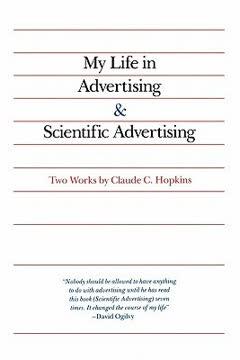
Advertising has a reputation problem. For most of its history, it has been treated as a creative pursuit, a matter of inspiration, intuition, and artistic flair. Companies poured money into campaigns based on hunches. Agencies won accounts with clever slogans and beautiful layouts. And nobody could reliably predict which advertisements would work and which would fail. Claude C. Hopkins found this unacceptable. Born in 1866, Hopkins entered the advertising world when it was still in its infancy. He worked for Bissell carpet sweepers, Swift & Company, Schlitz beer, Quaker Oats, Pepsodent toothpaste, and dozens of other brands that became household names. He did not succeed because he was more creative than his peers. He succeeded because he refused to guess. Hopkins treated advertising as a laboratory. He ran controlled experiments. He tracked responses. He calculated the exact cost of acquiring each customer. When something worked, he did more of it. When something failed, he killed it immediately. Over decades of relentless testing, he discovered that advertising operates according to fixed principles, principles that remain as true today as they were a century ago. The two books collected here, My Life in Advertising and Scientific Advertising, tell the story of how Hopkins developed his methods and what he learned along the way. The first is a memoir filled with real campaigns, real numbers, and real lessons from the trenches. The second is a distilled manual of advertising principles, written to teach others what he had spent a lifetime learning. What makes these books remarkable is their enduring relevance. The platforms have changed. Newspapers have become websites. Coupons have become promo codes. But human nature has not changed. The way people respond to offers, the way they justify purchases, the way they resist being sold to, all of this remains constant. The principles Hopkins discovered apply to every form of persuasion, from a direct mail letter to a social media campaign. The central…
Continue reading in the MinuteRead app
Get the complete 30-minute summary of My Life in Advertising and Scientific Advertising
Get the complete summary in the appTreat advertising as a science. Test everything and let the data guide your decisions.
Write like a salesperson. Address the customer's needs, provide proof, and ask for the order.
Put the customer first. Offer service before asking for the sale.
Make your headline select the right audience. Speak directly to the people who need your product.
Be specific. Concrete facts persuade. Vague claims are ignored.
Tell a complete story in every advertisement. Do not rely on prior knowledge or future exposure.
"My Life in Advertising and Scientific Advertising" is a strong fit if you want practical ideas around business, biography, science, especially themes like treat advertising as a science. test everything and let the data guide your decisions; write like a salesperson. address the customer's needs, provide proof, and ask for the order. The MinuteRead summary distills these concepts into a focused read, whether you're deciding whether to buy the book or applying its lessons at work.
Claude C. Hopkins was a pioneering advertiser in the early 20th century, known for his scientific approach to advertising. He worked extensively in the field, often putting in 16-18 hour days to understand products and customers. Hopkins developed many techniques still used today, including coupon-based promotions and A/B testing. He believed in the power of sampling and demonstration to sell products. His career included work for major brands like Quaker Oats, Pepsodent, and Palmolive. Hopkins'…
View all summaries by Claude C. HopkinsContinue Reading
Access the complete 30-minute summary and thousands more nonfiction books in the MinuteRead app.

Continue reading the complete summary in the MinuteRead app.






