MinuteRead
30 min
Book summary
Premium summary · Opens in the app · 30 min read
Every day, you make thousands of choices. Some are trivial: coffee or tea, walk or drive, save or spend. Others carry more weight: which career to pursue, whether to buy a home, how to vote. Each choice involves trade-offs. Each trade-off involves costs. And each cost shapes the world you live in.
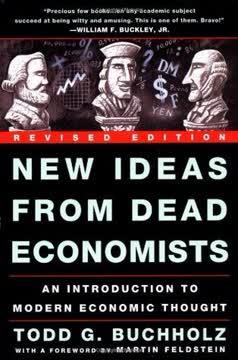
### An Introduction to Modern Economic Thought
**By Todd G. Buchholz**
**Estimated Reading Time:** 4 hours 15 minutes
**What You'll Learn:**
- Why economics is fundamentally about human choice, not just money - How the great economic thinkers shaped the modern world - What Adam Smith really meant by the invisible hand - Why Karl Marx's predictions failed and what he got right - How marginal thinking revolutionized economics - What public choice theory reveals about politicians - Why rational expectations changed government policy forever - How to apply centuries of economic wisdom to your own decisions
**Who This Book Is For:**
This book is for anyone who wants to understand the ideas that quietly govern our world. You do not need a background in economics. You do not need to love math. You only need curiosity about why societies prosper or fail, why some policies work while others backfire, and how the choices of ordinary people create the complex systems we call economies. If you have ever wondered whether free trade helps or hurts, whether government can fix recessions, or why some nations grow rich while others stay poor, this book will give you the intellectual tools to think clearly about these questions.
Every day, you make thousands of choices. Some are trivial: coffee or tea, walk or drive, save or spend. Others carry more weight: which career to pursue, whether to buy a home, how to vote. Each choice involves trade-offs. Each trade-off involves costs. And each cost shapes the world you live in. Most people think economics is about money. It is not. Economics is about choice. It is the study of how individuals, businesses, and governments decide among competing alternatives when resources are scarce. Scarcity is the fundamental condition of human existence. We cannot have everything we want. We cannot be in two places at once. We cannot spend the same dollar twice. So we choose, and our choices have consequences. This book tells the story of the thinkers who taught us how to understand those choices. It is a history of ideas, but not a dusty one. The economists in these pages were not detached academics scribbling equations in ivory towers. They were passionate, flawed, brilliant human beings who wrestled with the great questions of their age: Why are some nations rich and others poor? What causes depressions? Can government improve our lives, or does it usually make things worse? What happens when populations grow faster than food supplies? Does capitalism contain the seeds of its own destruction? These questions are not settled. They are alive in every election, every business decision, every family budget. When a politician promises to create jobs by raising tariffs,…
Continue reading in the MinuteRead app
Get the complete 30-minute summary of New Ideas from Dead Economists
Get the complete summary in the app**Economics is about choice, not just money.** Every decision involves trade-offs, and understanding those trade-offs is
**The invisible hand is real but needs rules.** Markets coordinate human activity remarkably well, but they need laws, n
**Specialization creates wealth.** The division of labor increases productivity and raises living standards. Focus on wh
**Comparative advantage means everyone can benefit from trade.** Even if you are worse at everything, you can still bene
**The harm principle is a useful guide for policy.** The only justification for limiting liberty is to prevent harm to o
**Marx was wrong about the collapse of capitalism but right about alienation.** The critique of capitalism's social cost
"New Ideas from Dead Economists" is a strong fit if you want practical ideas around economics, history, business, especially themes like **economics is about choice, not just money.** every decision involves trade-offs, and understanding those trade-offs is; **the invisible hand is real but needs rules.** markets coordinate human activity remarkably well, but they need laws, n. The MinuteRead summary distills these concepts into a focused read, whether you're deciding whether to buy the book or applying its lessons at work.
Todd G. Buchholz is a prominent American economist with extensive experience in academia, government, and business. He served as a senior economic advisor at the White House and was considered for the Federal Reserve. Buchholz holds degrees from prestigious institutions and has taught at Harvard. He is a prolific writer and commentator, contributing to major publications and appearing on television networks. Buchholz is involved in various business ventures and speaks globally on economic issues…
View all summaries by Todd G. BuchholzContinue Reading
Access the complete 30-minute summary and thousands more nonfiction books in the MinuteRead app.

Continue reading the complete summary in the MinuteRead app.