MinuteRead
30 min
Book summary
Premium summary · Opens in the app · 30 min read
Every day, millions of small business owners wake up and make the same mistake. They open their checkbooks, hand money to advertising salespeople, and hope something good happens. They buy ads that look beautiful but produce nothing. They build websites that win design awards but attract no customers. They post on social media, collect likes and followers, and wonder why their cash register remains silent.
**Author:** Dan S. Kennedy **Estimated Reading Time:** 45 minutes
**What You'll Learn:** - Why most small business marketing fails and what to do instead - How to craft offers that generate immediate sales - The discipline required to make every marketing dollar accountable - How to build a complete direct marketing system that produces measurable results
**Who This Book Is For:** Business owners, entrepreneurs, and marketers who are tired of spending money on advertising that produces no measurable return. If you want marketing that sells rather than marketing that merely looks good, this book is for you.
Every day, millions of small business owners wake up and make the same mistake. They open their checkbooks, hand money to advertising salespeople, and hope something good happens. They buy ads that look beautiful but produce nothing. They build websites that win design awards but attract no customers. They post on social media, collect likes and followers, and wonder why their cash register remains silent. Dan Kennedy has watched this tragedy unfold for decades. He has consulted with businesses ranging from solo practitioners to multinational corporations, and he has identified a fundamental problem: most ordinary businesses market like big brand-name companies. They chase image, visibility, and presence. They measure success in impressions, reach, and engagement. They convince themselves that if enough people see their name, sales will eventually follow. This is a lie that costs small businesses billions of dollars every year. The truth is that big companies play a different game. Procter & Gamble spends hundreds of millions on brand advertising because they have hundreds of millions to spend. They can afford to wait years for brand awareness to translate into sales. They answer to stockholders who care about market share and brand equity. Their agenda is fundamentally different from yours. Your agenda is simple: sell something now. Kennedy's message is direct and unapologetic. Stop acting like a lion when you're a rabbit. Stop mimicking strategies that only work for companies with massive budgets and patient investors. Instead, embrace the discipline of direct marketing, a system built on a simple premise: every dollar you spend on marketing should produce a measurable, trackable return. Direct marketing is not new. It has been refined over more than a century by mail-order pioneers, catalog merchants, and infomercial producers. These marketers never had the luxury of spending money on vague notions of brand awareness. They had to make every advertisement pay for itself. They had to know, down to the penny, what each campaign produced. They had to be accountable. This accountability is what makes direct marketing so powerful and so intimidating. When you practice direct marketing, you cannot hide behind pretty ads and vague metrics.…
Continue reading in the MinuteRead app
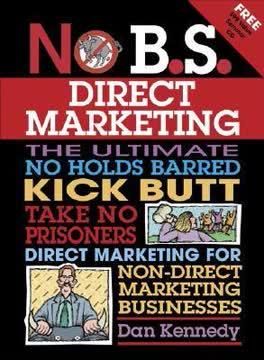
Get the complete 30-minute summary of No B.S. Direct Marketing
Get the complete summary in the appEvery marketing dollar must produce a measurable return.
Every marketing communication must include a specific offer.
Create urgency to overcome procrastination.
Provide clear instructions for responding.
Track everything and hold every campaign accountable.
Focus on response, not brand building.
"No B.S. Direct Marketing" is a strong fit if you want practical ideas around business, entrepreneurship, self help, especially themes like every marketing dollar must produce a measurable return; every marketing communication must include a specific offer. The MinuteRead summary distills these concepts into a focused read, whether you're deciding whether to buy the book or applying its lessons at work.
Dan S. Kennedy is a prolific author, entrepreneur, and marketing consultant known for his No B.S. book series and business advice. He has written numerous books on marketing and entrepreneurship, influencing over a million business owners annually through various channels. Kennedy has shared speaking platforms with former U.S. Presidents, business celebrities, and renowned entrepreneurs. As a direct-response marketing consultant, he commands high fees for crafting marketing campaigns across vari…
View all summaries by Dan S. KennedyContinue Reading
Access the complete 30-minute summary and thousands more nonfiction books in the MinuteRead app.

Continue reading the complete summary in the MinuteRead app.