MinuteRead
5 min
Book summary
Premium summary · Opens in the app · 5 min read
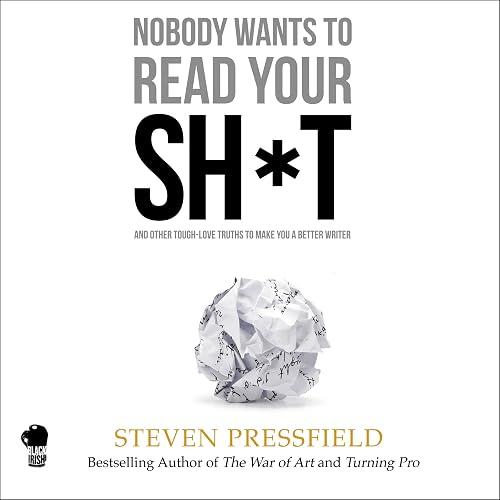
Nobody Wants to Read Your Sh*t combines countless lessons Steven Pressfield has learned from succeeding as a writer in advertising, the movie industry, fiction, non-fiction, and self-help, in order to help you write like a pro.
Nobody Wants to Read Your Sh*t combines countless lessons Steven Pressfield has learned from succeeding as a writer in advertising, the movie industry, fiction, non-fiction, and self-help, in order to help you write like a pro.
Steve started his writing career as a copywriter when he was 19. One of the first things he learned in the world of slogans is that each campaign must put a unique spin on an existing idea. Everyone hates commercials and most people even hate reading, so whatever you float in front of their eyes better cause strong emotions.
Whether the reaction is “interesting,” “outrageous,” or “wow,” the perspective you provide has to temporarily shut out all other perspectives by approaching a known issue from a completely different angle. An example Steve makes is that number two players in big industries, like fast food, the soda market or rental cars, can turn their silver medal into gold by embracing it. That’s why 7Up calls itself the “uncola” and Avis promises to “try harder.”
In the same vein, when diamonds were first marketed as a token of eternal love, this allowed them to displace all other rare commodities in the jewelry market. After all, if you’re not proposing to someone you’ll love forever, what the hell are you doing?
Before you write the first line, come up with a concept.
Thousands of hours of writer’s block are caused around the world each and every single day by two seemingly simple questions:
What do I write about? How am I going to say what I want to say?
Much Resistance can be eliminated by replacing those two with one, much simpler question: What’s the problem here? When you think of your writing as a way to solve a problem, you’re well on your way towards the solution, because the solution always lies within the problem itself.
For example, the problem of the companies we talked about was that their product was good, but not selling as much as their main competitor. Once you see you’re trailing behind, you can think about what to do with that. You could openly admit it and state how you plan to win, or distance yourself from playing that game altogether.
All writing solves problems, whether it shows us how to make a lasagna in seven easy steps or transforms our sense of self through an epic, 700-page journey. Figure out the problem and you’ll find the solution.
Boy loses his father, evil servant takes the throne, orphan prince grows up and wins it back. That’s The Lion King. And, with a few tweaks, a sub-plot in Lord of the Rings, Aladdin and Prince of Persia. All fantastic stories with the…
Continue reading in the MinuteRead app
Get the complete 5-minute summary of Nobody Wants to Read Your Sh*t
Get the complete summary in the appEvery piece of writing must have a concept.
Writers solve problems.
Three-act structure applies to all writing.
"Nobody Wants to Read Your Sh*t" is a strong fit if you want practical ideas around communication skills, creativity, marketing, especially themes like every piece of writing must have a concept; writers solve problems. The MinuteRead summary distills these concepts into a focused read, whether you're deciding whether to buy the book or applying its lessons at work.
Steven Pressfield is the author of The War of Art which has sold over a millions copies globally and been translated into multiple languages. He is a master of historical fiction with Gates of Fire being on the required reading list at West Point and the the recommended reading list of the Joint Chiefs. His other books include A Man at Arms, Turning Pro, Do the Work, The Artist's Journey, Tides of War, The Legend of Bagger Vance, Last of the Amazons, Virtues of War, The Afghan Campaign, Killing …
View all summaries by Steven PressfieldContinue Reading
Access the complete 5-minute summary and thousands more nonfiction books in the MinuteRead app.

Continue reading the complete summary in the MinuteRead app.