MinuteRead
30 min
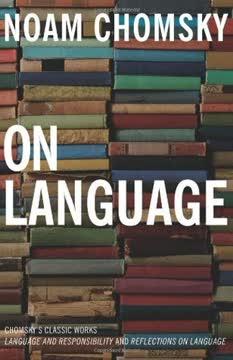
Book summary
by Noam Chomsky
Premium summary · Opens in the app · 30 min read
Language is so familiar that we rarely stop to consider how extraordinary it is. Every day, you produce and understand sentences you have never heard before. You express thoughts that have never been expressed in exactly the same way. You grasp meanings instantly, often without conscious effort. A child, within a few short years, masters a system of staggering complexity, one that allows for infinite creativity within a finite set of rules.
**Author:** Noam Chomsky
**Estimated Reading Time:** 45 minutes
**What You'll Learn:**
- Why language is a window into the structure of the human mind - How children acquire complex linguistic knowledge with astonishing speed - What Universal Grammar reveals about human nature - Why the creative use of language remains one of science's deepest mysteries - How linguistic theory connects to questions of freedom, creativity, and social organization
**Who This Book Is For:**
This book is for anyone who has ever wondered how language works, why children learn to speak so effortlessly, or what our linguistic abilities reveal about what it means to be human. You do not need a background in linguistics to understand these ideas. Chomsky himself insists that the fundamental questions about language are accessible to anyone willing to think carefully. If you are curious about the mind, human nature, or the deep structures that shape our thoughts and expressions, this book will reward your attention.
Language is so familiar that we rarely stop to consider how extraordinary it is. Every day, you produce and understand sentences you have never heard before. You express thoughts that have never been expressed in exactly the same way. You grasp meanings instantly, often without conscious effort. A child, within a few short years, masters a system of staggering complexity, one that allows for infinite creativity within a finite set of rules. Yet when we pause to examine language closely, it becomes deeply puzzling. How does a child learn something so intricate so quickly? Why do all human languages share fundamental structural properties despite their surface differences? What does our linguistic ability reveal about the nature of the human mind? Noam Chomsky has spent decades confronting these questions. His work transformed linguistics from a descriptive discipline into a rigorous science that probes the deepest structures of human cognition. In doing so, he sparked what became known as the cognitive revolution, a fundamental shift in how we understand the mind. The central claim running through Chomsky's work is both simple and profound: language is a mirror of the mind. By studying the structure of language, we gain unique insights into the organization and nature of human cognitive capacities. Language is not merely a tool for communication. It is a biological system, a mental organ that develops naturally in all humans, revealing the innate structures that shape how we think, perceive, and understand the world. This perspective challenges deeply held assumptions. For centuries, many philosophers and psychologists have viewed the mind as a blank slate, a passive receptacle shaped entirely by experience. According to this view, children learn language through imitation, reinforcement, and generalization. They hear speech around them, copy it, and gradually…
Continue reading in the MinuteRead app
Get the complete 30-minute summary of On Language
Get the complete summary in the appLanguage is a biological system that reveals the innate structure of the human mind.
Humans are born with a language faculty containing the principles of Universal Grammar.
Children acquire linguistic knowledge that is not present in their input, proving that some knowledge is innate.
The creative aspect of language use remains a scientific mystery.
Surface structure and deep structure explain how sentences with different forms can have similar meanings.
Movement leaves traces that explain how we understand complex sentences.
"On Language" is a strong fit if you want practical ideas around linguistics, philosophy, language, especially themes like language is a biological system that reveals the innate structure of the human mind; humans are born with a language faculty containing the principles of universal grammar. The MinuteRead summary distills these concepts into a focused read, whether you're deciding whether to buy the book or applying its lessons at work.
Avram Noam Chomsky is a renowned American linguist, philosopher, and political activist. As an Institute Professor Emeritus at MIT, he revolutionized linguistics with his theory of generative grammar and sparked the cognitive revolution in psychology. Chomsky's work has significantly influenced the fields of linguistics, psychology, and philosophy of mind. He developed the Chomsky hierarchy for classifying formal languages and became widely known for his media criticism and political activism, p…
View all summaries by Noam ChomskyContinue Reading
Access the complete 30-minute summary and thousands more nonfiction books in the MinuteRead app.

Continue reading the complete summary in the MinuteRead app.