MinuteRead
30 min
Book summary
Premium summary · Opens in the app · 30 min read
In the late 1970s, Stephen Krashen stood before an audience of language teachers and made a claim that sounded almost heretical. The elaborate methods, the carefully sequenced grammar drills, the memorized vocabulary lists, the anxious recitations in front of classmates: nearly all of it, he argued, was largely beside the point.
**Author:** Stephen D. Krashen **Estimated Reading Time:** 42 minutes
**What You'll Learn:**
- Why most language teaching fails despite enormous effort - The single mechanism that actually drives language acquisition - Why conscious grammar study plays only a marginal role - How emotions and psychology determine who succeeds and who struggles - What parents, teachers, and learners should do differently
**Who This Book Is For:**
Anyone who has ever tried to learn a language and felt frustrated. Anyone who has taught languages and wondered why students forget everything after the final exam. Anyone who wants to understand how the human brain actually acquires language, not how textbooks pretend it does.
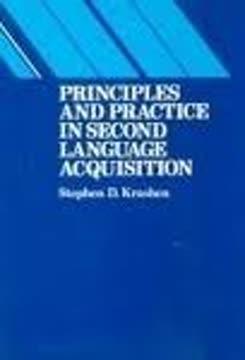
In the late 1970s, Stephen Krashen stood before an audience of language teachers and made a claim that sounded almost heretical. The elaborate methods, the carefully sequenced grammar drills, the memorized vocabulary lists, the anxious recitations in front of classmates: nearly all of it, he argued, was largely beside the point. The room was divided. Some teachers felt liberated. Others felt attacked. But the idea would not go away, because it matched something many educators had quietly suspected for years. Students who spent hundreds of hours in language classrooms often emerged unable to hold a basic conversation. Meanwhile, people who moved to a new country and simply lived their lives in a new language sometimes became fluent without a single formal lesson. Krashen's book, *Principles and Practice in Second Language Acquisition*, published in 1982, set out to explain this puzzle. It synthesized years of research into a coherent theory of how languages are actually acquired. The book became one of the most cited works in the field of applied linguistics, and its central ideas continue to shape debates about language education decades later. The problem Krashen addressed was not a small one. Millions of people around the world spend years studying foreign languages in school. They memorize verb conjugations. They complete fill-in-the-blank exercises. They pass tests. And then, when they encounter a native speaker, they freeze. The words do not come. The grammar rules they studied so diligently vanish under the pressure of real-time communication. This failure is not the fault of lazy students or incompetent teachers. It is the predictable result of a fundamental misunderstanding about how language acquisition works. The field of language teaching had been built on the assumption that conscious learning of rules leads to fluent use. Krashen argued that this assumption was wrong. His alternative was both simple and radical. Language is acquired through one primary mechanism: understanding messages. When learners are exposed to language they can comprehend, and when that language contains structures slightly beyond their current level, acquisition happens naturally and subconsciously. No…
Continue reading in the MinuteRead app
Get the complete 30-minute summary of Principles and Practice in Second Language Acquisition
Get the complete summary in the appLanguage is acquired through comprehensible input, not through conscious study or drills.
Acquisition is subconscious. Learning is conscious. They are separate systems that do not merge.
Conscious grammar knowledge serves only as a monitor, editing output after it has been produced.
Grammatical structures are acquired in a predictable natural order, regardless of teaching order.
The affective filter can block input. High anxiety, low motivation, and weak self-confidence prevent acquisition.
The best input is so interesting and relevant that learners forget they are hearing a foreign language.
"Principles and Practice in Second Language Acquisition" is a strong fit if you want practical ideas around inspiration, language, linguistics, especially themes like language is acquired through comprehensible input, not through conscious study or drills; acquisition is subconscious. learning is conscious. they are separate systems that do not merge. The MinuteRead summary distills these concepts into a focused read, whether you're deciding whether to buy the book or applying its lessons at work.
Stephen D. Krashen is a prominent linguist and educational researcher who has made significant contributions to the field of second-language acquisition. As professor emeritus at the University of Southern California, he has published extensively, introducing influential concepts such as the input hypothesis and the affective filter. Krashen advocates for free voluntary reading in language education and has been active in promoting bilingual education. His work has had a lasting impact on langua…
View all summaries by Stephen D. KrashenContinue Reading
Access the complete 30-minute summary and thousands more nonfiction books in the MinuteRead app.

Continue reading the complete summary in the MinuteRead app.