MinuteRead
30 min
Book summary
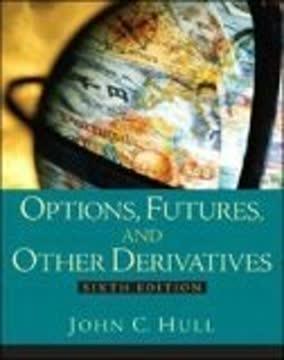
by John C. Hull
Premium summary · Opens in the app · 30 min read
In the decades since financial derivatives first emerged as specialized instruments traded by a small circle of professionals, they have grown into one of the largest and most consequential markets in the world. The notional value of outstanding derivatives contracts runs into the hundreds of trillions of dollars, a figure so large it can seem abstract. Yet behind that number lies a simple truth: derivatives touch nearly every corner of the global economy.
**Author:** John C. Hull
**Estimated Reading Time:** 45 minutes
**What You'll Learn:**
- Why derivatives are essential tools in modern finance, not dangerous gambling instruments - How futures markets work and why clearinghouses make trading safer - The mechanics of hedging with futures and options - How the Black-Scholes-Merton model revolutionized options pricing - What volatility smiles reveal about market psychology - How credit derivatives transfer risk across the financial system - The numerical methods used to price complex derivatives
**Who This Book Is For:**
This condensed edition is for anyone who wants to understand the machinery of modern financial markets. Whether you are a student preparing for a career in finance, a professional seeking to deepen your knowledge, an investor trying to understand the instruments that move markets, or simply a curious reader who wants to know what derivatives actually do, this book will give you a rigorous yet accessible foundation. No prior knowledge of derivatives is assumed, but a basic familiarity with financial concepts will help.
In the decades since financial derivatives first emerged as specialized instruments traded by a small circle of professionals, they have grown into one of the largest and most consequential markets in the world. The notional value of outstanding derivatives contracts runs into the hundreds of trillions of dollars, a figure so large it can seem abstract. Yet behind that number lies a simple truth: derivatives touch nearly every corner of the global economy. A farmer in Iowa uses futures contracts to lock in a price for corn before the harvest. A European airline hedges its jet fuel costs to protect against volatile oil prices. A multinational corporation uses currency swaps to manage exchange rate exposure across dozens of countries. A pension fund uses interest rate derivatives to match its assets to its future liabilities. A bank uses credit default swaps to reduce its exposure to a corporate borrower. In each case, derivatives serve a practical purpose: they transfer risk from those who do not want it to those who are willing to bear it. Yet derivatives also carry a reputation for danger. The 2008 financial crisis, the collapse of Barings Bank, the losses at Metallgesellschaft, and other high-profile failures have created a perception that derivatives are inherently reckless instruments. This perception is understandable but incomplete. Derivatives are tools, and like any tool, their value depends on how they are used. A hammer can build a house or break a window. The hammer itself is neutral. John Hull's work has spent decades explaining this duality. As a professor at the University of Toronto's Rotman School of Management and a researcher whose Hull-White model is widely used in practice, Hull occupies a rare position:…
Continue reading in the MinuteRead app
Get the complete 30-minute summary of Options, Futures and Other Derivatives
Get the complete summary in the appDerivatives transfer risk from those who do not want it to those who are willing to bear it.
Futures markets use clearinghouses and margin requirements to eliminate counterparty risk.
Hedging reduces the variance of outcomes, not the expected outcome.
Forward prices are determined by arbitrage through the cost-of-carry relationship.
The Black-Scholes-Merton model prices options by constructing a riskless replicating portfolio.
Volatility is the most important and least observable input to option pricing.
"Options, Futures and Other Derivatives" is a strong fit if you want practical ideas around finance, economics, business, especially themes like derivatives transfer risk from those who do not want it to those who are willing to bear it; futures markets use clearinghouses and margin requirements to eliminate counterparty risk. The MinuteRead summary distills these concepts into a focused read, whether you're deciding whether to buy the book or applying its lessons at work.
John C. Hull is a prominent figure in quantitative finance, serving as a Professor of Derivatives and Risk Management at the University of Toronto's Rotman School of Management. He is renowned for his contributions to academic research, including the Hull-White model. Hull's books, particularly "Options, Futures, and Other Derivatives" and "Fundamentals of Futures and Options Markets," have become standard texts for market practitioners. His work bridges the gap between academic theory and pract…
View all summaries by John C. HullContinue Reading
Access the complete 30-minute summary and thousands more nonfiction books in the MinuteRead app.

Continue reading the complete summary in the MinuteRead app.