 MinuteRead
30 min
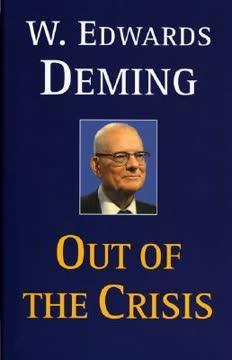
In 1950, W. Edwards Deming stood before a group of Japanese executives and told them something that sounded absurd. He said that if they would listen to him, they could capture the world market for manufactured goods within five years. The executives listened. They took notes. They went home and applied what he taught them. Within a generation, Japanese products went from being a global joke to the gold standard of quality. The rest of the world spent decades trying to catch up.
**Author:** W. Edwards Deming **Estimated Reading Time:** 42 minutes
Why the Western style of management is fundamentally broken, how statistical thinking reveals problems that traditional management hides, and what specific principles can transform an organization from decline into sustained success. You will learn the difference between common and special causes of variation, why most performance problems belong to the system rather than the worker, and how the Fourteen Points provide a coherent philosophy for staying in business.
This book is for managers, executives, engineers, and anyone responsible for improving the performance of an organization. It is also for workers who have felt the frustration of being blamed for problems they did not create. If you have ever wondered why hard work and good intentions fail to produce better results, this book will show you what is actually happening.
In 1950, W. Edwards Deming stood before a group of Japanese executives and told them something that sounded absurd. He said that if they would listen to him, they could capture the world market for manufactured goods within five years. The executives listened. They took notes. They went home and applied what he taught them. Within a generation, Japanese products went from being a global joke to the gold standard of quality. The rest of the world spent decades trying to catch up. Deming wrote *Out of the Crisis* in 1982, after watching American industry ignore the lessons he had taught in Japan. The book is not a gentle suggestion. It is a diagnosis of a fatal disease and a prescription for survival. Deming believed that the Western style of management, with its obsession over short-term profits, its reliance on inspection, its numerical quotas, and its annual performance reviews, was destroying the ability of American companies to compete. He was not describing a temporary downturn. He was describing a structural failure. The problem, as Deming saw it, is that most managers do not understand variation. They look at a number that went up or down and assume someone did something right or wrong. They reward the lucky and punish the unlucky. They set goals without understanding the capability of the system. They demand better results while doing nothing to improve the processes that produce those results. The result is a workforce that is demoralized, a management that is confused, and a company that is slowly dying. Deming's approach is different because it is built on a foundation of statistical thinking. He did not ask managers to try harder. He asked them to think differently. He showed that quality is not achieved by inspecting products at the end of the line. It is achieved by improving the system that produces the products. He…
Continue reading in the MinuteRead app
Get the complete 30-minute summary of Out of the Crisis
Get the complete summary in the appQuality is defined by the customer, and the customer's needs are constantly changing.
Improving quality reduces costs. Poor quality creates waste.
About 94 percent of problems come from the system. Only 6 percent come from individual workers.
Blaming workers for system problems is tampering. It makes things worse.
Use control charts to distinguish between common and special causes of variation.
React only to special causes. Leave stable processes alone.
"Out of the Crisis" is a strong fit if you want practical ideas around business, management, leadership, especially themes like quality is defined by the customer, and the customer's needs are constantly changing; improving quality reduces costs. poor quality creates waste. The MinuteRead summary distills these concepts into a focused read, whether you're deciding whether to buy the book or applying its lessons at work.
W. Edwards Deming was an American engineer, statistician, professor, author, and management consultant. He is best known for his work in Japan after World War II, where he taught top management how to improve design, product quality, testing, and sales through various methods, including statistical process control. Deming's ideas and methods significantly contributed to Japan's economic recovery and rise to become the second-largest economy in the world by 1960. He later brought his management m…
View all summaries by W. Edwards DemingContinue Reading
Access the complete 30-minute summary and thousands more nonfiction books in the MinuteRead app.

Continue reading the complete summary in the MinuteRead app.






