MinuteRead
30 min
Book summary
Premium summary · Opens in the app · 30 min read
Most teams are not really teams. They are collections of individuals who report to the same person, sit in the same meetings, and share the same organizational chart. They may call themselves a team, but they operate more like a committee, a working group, or what Patrick Lencioni calls a "co-op" of independent contributors.
**Author:** Patrick Lencioni
**Estimated Reading Time:** 45 minutes
**What You'll Learn:** How to build a genuinely cohesive team by addressing the five root causes of dysfunction: absence of trust, fear of conflict, lack of commitment, avoidance of accountability, and inattention to results. You will learn practical tools and exercises to transform your team's behavior and performance.
**Who This Book Is For:** Team leaders, executives, managers, and anyone who works as part of a team and wants to understand why teamwork is so often harder than it should be, and what to do about it.
Most teams are not really teams. They are collections of individuals who report to the same person, sit in the same meetings, and share the same organizational chart. They may call themselves a team, but they operate more like a committee, a working group, or what Patrick Lencioni calls a "co-op" of independent contributors. The problem is not a lack of intelligence. The problem is not a lack of effort. The problem is not even a lack of desire. The problem is that genuine teamwork is hard, and it is hard in ways that most people do not fully understand. Lencioni's work with executive teams across hundreds of organizations revealed a consistent pattern. Teams fail not because of external threats, market conditions, or strategic errors. They fail because of internal dynamics that go unaddressed. They fail because leaders and team members avoid uncomfortable conversations. They fail because they mistake politeness for trust, agreement for commitment, and individual success for collective achievement. The cost of dysfunctional teamwork is enormous. Decisions take too long. Meetings are frustrating and unproductive. Politics and gossip fill the vacuum left by absent candor. Talented people disengage. Good strategies die in execution because the people responsible for implementing them are not aligned. The organization survives, but it never thrives. What makes this particularly tragic is that the solution is not complicated. It does not require expensive technology, elaborate restructuring, or hiring a new team of superstars. It requires a willingness to be honest, vulnerable, and disciplined about five specific behaviors. The five dysfunctions are not independent problems. They form a chain. Each dysfunction feeds the next. Absence of trust leads to fear of conflict. Fear of conflict leads to lack of commitment. Lack of commitment leads to avoidance of accountability. Avoidance of accountability leads to inattention to results. The chain works in reverse too. When a team focuses on collective results, it becomes easier to hold one another accountable. When accountability is present, commitment deepens. When commitment is real, conflict becomes productive. And when conflict is productive, trust grows. This book is a practical guide to breaking that chain. It is not a…
Continue reading in the MinuteRead app
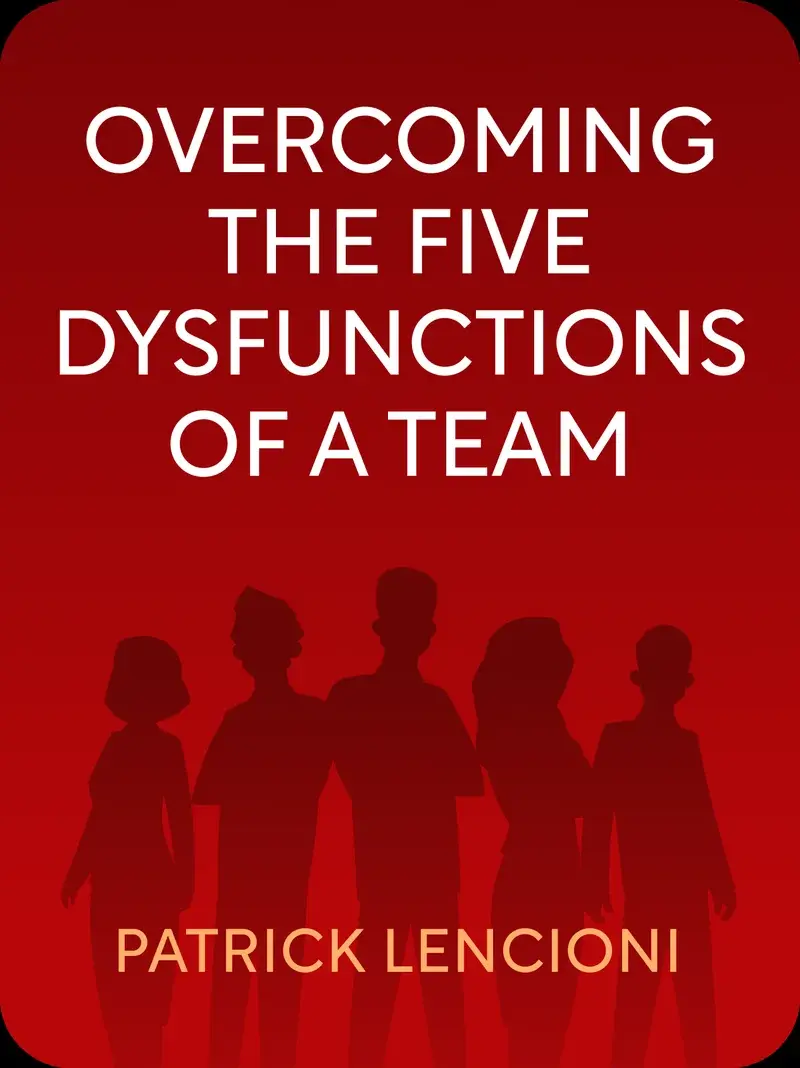
Get the complete 30-minute summary of Overcoming the Five Dysfunctions of a Team
Get the complete summary in the appTrust is built through vulnerability, not through time spent together.
Healthy teams engage in passionate, unfiltered debate about ideas.
Commitment requires clarity and buy-in, not unanimous agreement.
Peer accountability is more effective than leader accountability.
Focus on collective results, not individual achievements.
The leader must model the behaviors they want to see.
"Overcoming the Five Dysfunctions of a Team" is a strong fit if you want practical ideas around leadership, business, management, especially themes like trust is built through vulnerability, not through time spent together; healthy teams engage in passionate, unfiltered debate about ideas. The MinuteRead summary distills these concepts into a focused read, whether you're deciding whether to buy the book or applying its lessons at work.
Motivated to help readers with trust is not the ability of team members to predict one another's behaviors because they've known each other, Patrick Lencioni wrote “Overcoming the Five Dysfunctions of a Team” to package those ideas for a fast, focused read. In “Overcoming the Five Dysfunctions of a Team”, Patrick Lencioni focuses on trust is not the ability of team members to predict one another's behaviors because they've known each other. Through “Overcoming the Five Dysfunctions of a Team”, P…
View all summaries by Patrick LencioniContinue Reading
Access the complete 30-minute summary and thousands more nonfiction books in the MinuteRead app.

Continue reading the complete summary in the MinuteRead app.