MinuteRead
30 min
Book summary
Premium summary · Opens in the app · 5 min read
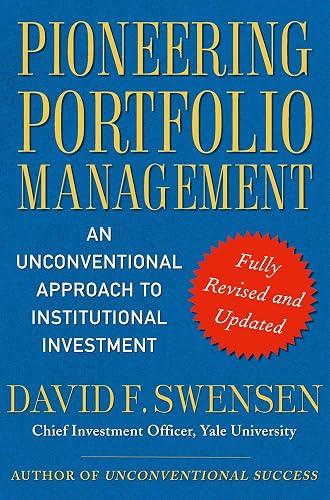
Pioneering Portfolio Management is a financial book that touches on subjects like institutional investments, asset classes, securities management, and how to adjust a portfolio based on risk, a diversified approach to investing, and overall asset allocation.
Pioneering Portfolio Management is a financial book that touches on subjects like institutional investments, asset classes, securities management, and how to adjust a portfolio based on risk, a diversified approach to investing, and overall asset allocation.
Many organizations around the world, whether they’re public institutions, universities or colleges, charities or trusts, or even NGOs, have endowments that ensure their long-term success. An endowment is a donation received by an institution from an individual or another institution, which has to be kept under the receiving organization’s ownership for as long as they function.
Although the receiving organization can benefit from an endowment through interest or other financial benefits that may arise, the endowment can’t be sold, so as to ensure the perpetuating prosperity of the organization.
For example, an alumnus donated 96 acres of land to Yale in 1996, which is considered an endowment. Reaping the benefits, such as interest, helps Yale keep their financial status in great parameters. Although they are crucial for long-term success, some people may not rush when it comes to accepting endowments.
The uncomfortable aspect of receiving them as an institution is that the donor may require the organization to carry out research in different fields upon request, use the funds in a certain way, or take certain decisions that may not appeal to the executives of the enterprise. For this reason, not all donations go through as endowments.
A wise investor knows that in order to get on top of the game, they must invest in a smart way. That means considering the risk factor, the time frame, the securities they bet on, and many other crucial aspects. In fact, an investment analysis starts with three core aspects: Asset allocation Market timing Security selection Asset allocation implies picking the classes of assets that you’ll be investing in. This factor is the most important when it comes to forecasting returns. The second aspect, which is market timing, refers to seizing opportunities in the market based on current events. In the long strategy of an investor, there are moments to buy, moments to hold, and moments to sell. Market timing is all about that, and it can help investors pick security on discounts or avoid buying overpriced ones. Lastly, there’s the security selection. Here an investor decides if they’re going to be active or passive in their approach. A passive investor mimics the market and does not actively pick or trade their securities in the short-term or long-term strategy, because the market returns a higher average than most investors can on their own. Therefore a passive strategy is more successful in highly efficient markets (bonds, stocks). In contrast, active investors do their own research and pick their…
Continue reading in the MinuteRead app
Get the complete 5-minute summary of Pioneering Portfolio Management
Get the complete summary in the appA successful long-term strategy of an institution usually includes endowments
When investing, you must take into consideration three core aspects
Diversifying your portfolio is one of the most powerful principles of investing
"Pioneering Portfolio Management" is a strong fit if you want practical ideas around business, economics, entrepreneurship, especially themes like a successful long-term strategy of an institution usually includes endowments; when investing, you must take into consideration three core aspects. The MinuteRead summary distills these concepts into a focused read, whether you're deciding whether to buy the book or applying its lessons at work.
David F. Swensen is the chief investment officer of Yale University and the bestselling author of Pioneering Portfolio Management. He serves on the boards of TIAA, The Brookings Institution, Carnegie Institution, and Hopkins School. At Yale, where he produced an unparalleled two-decade investment record of 16.1 percent-per-annum returns, he teaches economics classes at Yale College and finance classes at Yale¹s School of Management. Mr. Swensen lives in New Haven, Connecticut.
View all summaries by David F. SwensenContinue Reading
Access the complete 5-minute summary and thousands more nonfiction books in the MinuteRead app.

Continue reading the complete summary in the MinuteRead app.