MinuteRead
30 min
Book summary
Premium summary · Opens in the app · 30 min read
Most corporate training fails. Not because the content is wrong. Not because the instructors lack expertise. It fails because it treats learning as a passive activity, something delivered to people rather than something people do.
**Author:** Sharon Boller with Karl Kapp
**Estimated Reading Time:** 42 minutes
**What You'll Learn**
How to design, build, and implement learning games that genuinely outperform traditional instruction. You will discover why games work as teaching tools, how to align game mechanics with learning objectives, the prototyping process that catches failures early, and the practical logistics of launching a game in a real organization. Every chapter equips you to move from theory to a finished learning game.
**Who This Book Is For**
Instructional designers, trainers, corporate learning leaders, educators, and anyone who has ever suspected that lectures and slide decks leave too much potential on the table. If you want to create learning experiences people actually want to complete, this book is your blueprint.
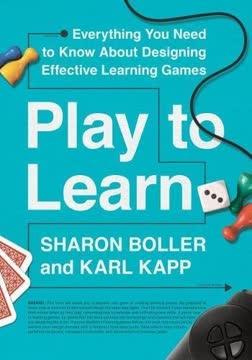
Most corporate training fails. Not because the content is wrong. Not because the instructors lack expertise. It fails because it treats learning as a passive activity, something delivered to people rather than something people do. The evidence is everywhere. Employees click through e-learning modules while answering emails. Conference attendees check phones under tables. New hires endure days of orientation and retain almost nothing a week later. The intention behind these programs is often good. The execution is not. Sharon Boller and Karl Kapp wrote Play to Learn to solve a specific problem: learning professionals know games might help, but they do not know how to build them. They sense that a well-designed game could transform a boring compliance course into something memorable. They suspect that new hire training could be faster and stickier. But between that intuition and a finished learning game sits a vast gap of unanswered questions. What kind of game? How do you make sure people actually learn? What if it feels silly? What if it costs too much? What if nobody plays it? This book closes that gap. It is not a theoretical argument for why games are good. It is a practical manual for creating them. Boller and Kapp bring decades of combined experience designing learning games for major corporations, government agencies, and educational institutions. They have made every mistake possible and learned what actually works. The research supporting game-based learning is strong. Multiple meta-analyses show that serious games outperform traditional instruction across measures of knowledge, skill, and retention. One study found game-based trainees had 11 percent higher declarative knowledge, 14 percent higher procedural knowledge, and 9 percent higher retention. Another found games especially effective when combined with other instructional methods and multiple sessions. The question is no longer whether games work. The question is how to build them well. This book answers that question from start to finish. It begins with the business case and learning objectives, moves through game design…
Continue reading in the MinuteRead app
Get the complete 30-minute summary of Play to Learn
Get the complete summary in the appStart with a measurable business problem, not a game idea.
Align game mechanics with learning objectives so winning requires learning.
Aim for "fun enough" to sustain engagement, not entertainment that competes with video games.
Prototype with paper before building anything digital.
Test early, test often, and fix problems when they are cheap.
Never skip the debrief. It is where experience becomes transferable knowledge.
"Play to Learn" is a strong fit if you want practical ideas around professional development, game design, academic, especially themes like start with a measurable business problem, not a game idea; align game mechanics with learning objectives so winning requires learning. The MinuteRead summary distills these concepts into a focused read, whether you're deciding whether to buy the book or applying its lessons at work.
Sharon Boller is an author and expert in the field of instructional design and learning game development. She co-authored "Play to Learn" with Karl Kapp, combining their expertise to create a comprehensive guide on designing effective learning games. Boller's work focuses on helping instructional designers and trainers incorporate game elements into their teaching methods. Her approach emphasizes the importance of understanding learning objectives and aligning them with appropriate game mechanic…
View all summaries by Sharon BollerContinue Reading
Access the complete 30-minute summary and thousands more nonfiction books in the MinuteRead app.

Continue reading the complete summary in the MinuteRead app.