 MinuteRead
30 min
Book summary
Premium summary · Opens in the app · 30 min read
Every profession has its hierarchy. At the bottom are the technicians, competent people who execute tasks well but are easily replaced. Above them are the experts, specialists who possess deep knowledge and command respect for their mastery. But at the very top sits a different kind of professional altogether. This person is not necessarily the most technically brilliant. They may not have the most credentials or the longest list of publications. Yet when a crisis hits, when a decision carries e
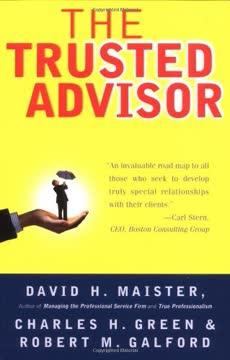
**Authors:** David H. Maister, Charles H. Green, Robert M. Galford
**Estimated Reading Time:** 45 minutes
**What You'll Learn:**
- Why trust is the single most important factor in professional success - The four-part equation that determines how trustworthy you appear - How to listen, frame problems, and build commitment with clients - The specific behaviors that separate trusted advisors from mere experts - A practical framework for deepening every client relationship
**Who This Book Is For:**
Professionals who advise others for a living. Consultants, lawyers, accountants, financial advisors, executive coaches, medical professionals, and anyone whose success depends on being sought out for counsel rather than simply delivering services. It is also for leaders who want to become the person others turn to when the stakes are high.
Every profession has its hierarchy. At the bottom are the technicians, competent people who execute tasks well but are easily replaced. Above them are the experts, specialists who possess deep knowledge and command respect for their mastery. But at the very top sits a different kind of professional altogether. This person is not necessarily the most technically brilliant. They may not have the most credentials or the longest list of publications. Yet when a crisis hits, when a decision carries enormous weight, when the future feels uncertain, clients reach for them first. These are the trusted advisors. The difference between an expert and a trusted advisor is not measured in IQ points or years of experience. It is measured in something far more valuable and far more difficult to build: trust. A client will accept a recommendation from an expert. A client will seek guidance from a trusted advisor. The distinction is subtle but profound. One is transactional. The other is transformational. Consider what happens when a client truly trusts you. They tell you things they have not told anyone else. They reveal their fears, their doubts, their hidden agendas, and their genuine constraints. They stop managing the conversation and start opening up. They ask questions they were afraid to ask. They admit what they do not know. This information is gold. It allows you to give advice that actually fits their situation rather than advice that merely sounds intelligent. Without trust, you are working in the dark. Clients give you partial information, sanitized versions of reality, carefully edited narratives designed to make them look good. You solve the wrong problems. You address surface issues while the real challenges fester underneath. Your recommendations, however brilliant, fail to land because they do not account for the human realities of the situation. This is why so many technically excellent professionals struggle to build thriving practices. They assume that expertise alone will attract clients and command…
Continue reading in the MinuteRead app
Get the complete 30-minute summary of The Trusted Advisor
Get the complete summary in the appTrust is the foundation of all effective client relationships.
Trustworthiness equals credibility plus reliability plus intimacy, divided by self-orientation.
Your job is to be helpful, not to be right.
Listen deeply before offering solutions.
Frame problems in ways that provide insight and clarity.
Help clients envision and commit to solutions collaboratively.
"The Trusted Advisor" is a strong fit if you want practical ideas around business, leadership, professional development, especially themes like trust is the foundation of all effective client relationships; trustworthiness equals credibility plus reliability plus intimacy, divided by self-orientation. The MinuteRead summary distills these concepts into a focused read, whether you're deciding whether to buy the book or applying its lessons at work.
David H. Maister is a renowned management consultant and author specializing in professional service firms. David H. Maister co-authored "The Trusted Advisor" with Charles H. Green and Robert M. Galford, drawing on their extensive experience in consulting. Maister has written several other influential books on professional services management, including "Managing the Professional Service Firm" and "True Professionalism." He is known for his expertise in strategy, marketing, and organizational de…
View all summaries by David H. MaisterContinue Reading
Access the complete 30-minute summary and thousands more nonfiction books in the MinuteRead app.

Continue reading the complete summary in the MinuteRead app.






