MinuteRead
30 min
Book summary
by Ken Watanabe
Premium summary · Opens in the app · 5 min read
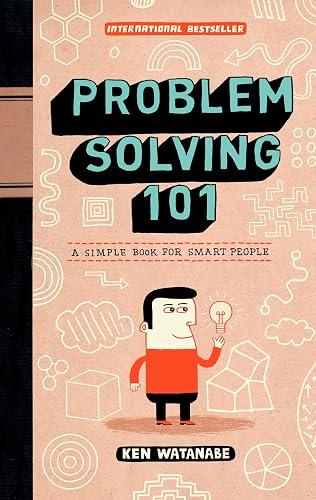
Problem Solving 101 is a universal, four-step template for overcoming challenges in life, based on a traditional method Japanese school children learn early on.
Problem Solving 101 is a universal, four-step template for overcoming challenges in life, based on a traditional method Japanese school children learn early on.
Let’s say you and your partner want to move in together and start a family. You’ve both entered the working world a couple years ago and are now looking to buy a home. However, once you look at your salaries and expenses, you realize you can’t afford the kind of home you want your future kids to grow up in. What could you do?
In this situation, most people would either resign to waiting for their next promotion or force themselves to randomly cut back on a big spending point. However, the trick to solving such a seemingly complex problem elegantly is to not jump at the above question in the first place. Instead, break down the problem into various aspects. In this example, “not enough money to pay mortgage for desired house” can be divided into “too little income,” “too high expenses,” and “expectations of future house.”
Once you have categories, it’s very easy to continue digging. Watanabe recommends decision trees. For example, you could now list causes for the “too little income” category, like “my company pays less than the industry average,” or “I didn’t get the promotion.” When going along these sub branches, you can mark each one with yes or no, to determine whether it’s actually part of the problem.
With a proper breakdown in hand, it’s much easier to analyze the causes and potential solutions of your problem.
Of course it’s impossible to be 100% objective when judging what lead to your problem, but that’s where analysis comes in. For each root cause that you marked with a yes in your decision tree, ask what data you need to verify your answer. For example, to see if your salary is below industry average, you can use Google to compare it to several statistics. And to figure out why you didn’t get promoted, ask coworkers when they were last promoted and come up with your own, company-internal data. The point of analysis is to never accept statements at face value, including your own. It gets you to pause and reflect before moving on, which is what makes it so valuable. That’s why it also applies to all potential solutions you subsequently brainstorm. If you want to confront your boss with the below average salary claim, you better bring lots of data from good sources to back it up. At the same time, if you find it’s easier to collect data for other solutions, like cutting your expenses on monthly subscriptions, because you still have all your receipts, analysis also helps you determine…
Continue reading in the MinuteRead app
Get the complete 5-minute summary of Problem Solving 101
Get the complete summary in the appThe first step of properly tackling any problem is to break it down.
Make sure you analyze all potential root problems and solutions by gathering data and reflecting.
When trying to find a solution, formulate multiple hypotheses, then test them one by one.
"Problem Solving 101" is a strong fit if you want practical ideas around business, career, creativity, especially themes like the first step of properly tackling any problem is to break it down; make sure you analyze all potential root problems and solutions by gathering data and reflecting. The MinuteRead summary distills these concepts into a focused read, whether you're deciding whether to buy the book or applying its lessons at work.
Motivated to help readers with universal, Ken Watanabe wrote “Problem Solving 101” to package those ideas for a fast, focused read. In “Problem Solving 101”, Ken Watanabe focuses on universal. Through “Problem Solving 101”, Ken Watanabe distills the core ideas on business into lessons readers can absorb in a single short sitting. Readers turn to this work when they want Ken Watanabe's perspective on the subject without working through the entire original volume. Ken Watanabe (渡辺 謙, Watanabe Ken;…
View all summaries by Ken WatanabeContinue Reading
Access the complete 5-minute summary and thousands more nonfiction books in the MinuteRead app.

Continue reading the complete summary in the MinuteRead app.