MinuteRead
30 min
Book summary
Premium summary · Opens in the app · 30 min read
The fear of public speaking ranks among the most common anxieties people report. Surveys consistently place it alongside or above the fear of heights, illness, and even death. Mark Twain reportedly joked that there are two types of speakers: those who are nervous and those who are liars. The physical symptoms are familiar to nearly everyone. Dry mouth. Racing pulse. Shaking hands. A mind that goes blank at the worst possible moment.
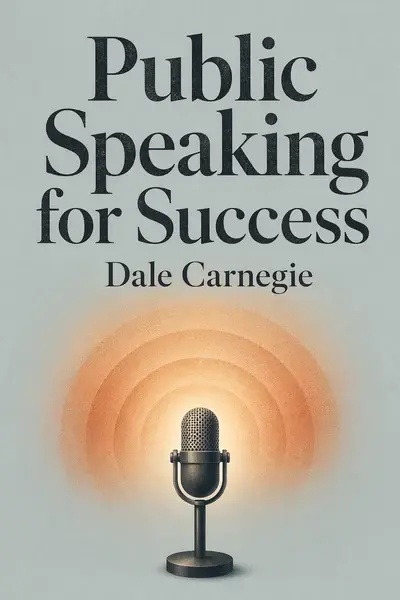
**Author:** Dale Carnegie **Estimated Reading Time:** 45 minutes
How to develop genuine confidence before any audience, structure messages that people remember, deliver them with natural conviction, and use your voice and body to reinforce rather than undermine your words. You will learn why preparation matters more than talent, how enthusiasm transforms delivery, and what separates speakers who connect from those who merely talk.
Anyone who has ever felt their heart race at the thought of standing before a group. Professionals who need to present ideas clearly. Leaders who must persuade and inspire. Students preparing for academic presentations. And anyone who suspects that their fear of public speaking is holding back their career, their influence, or their personal growth.
The fear of public speaking ranks among the most common anxieties people report. Surveys consistently place it alongside or above the fear of heights, illness, and even death. Mark Twain reportedly joked that there are two types of speakers: those who are nervous and those who are liars. The physical symptoms are familiar to nearly everyone. Dry mouth. Racing pulse. Shaking hands. A mind that goes blank at the worst possible moment. Yet the ability to speak well in front of others remains one of the most valuable skills a person can develop. It determines whether your ideas get heard or ignored. It shapes whether you are seen as competent or uncertain. It influences promotions, relationships, and the reach of your thinking. The person who can stand and speak clearly holds an advantage in nearly every field. Dale Carnegie understood this tension deeply. Born into poverty on a Missouri farm in 1888, he attended a state teachers college where he watched students who belonged to the debating society receive opportunities and respect that others did not. He wanted that same confidence. He failed repeatedly at first. He lost contests. He felt the sting of embarrassment. But he kept practicing, kept studying what worked, and eventually became a skilled speaker and teacher. Carnegie began teaching public speaking classes at a YMCA in New York City in 1912. He had no textbook and no established method. What he had was a simple observation: people learn to speak by speaking. His classes focused on practice, feedback, and building confidence through small successes. Students gave short talks, received encouragement, and gradually expanded their abilities. The method worked. His classes grew rapidly, and he spent decades refining his approach. The book draws on that experience. It is not a theoretical treatise on rhetoric. It is a practical guide built from watching thousands of ordinary people become competent, confident speakers. Carnegie believed that public speaking is not a natural gift reserved for a charismatic few. It is a…
Continue reading in the MinuteRead app
Get the complete 30-minute summary of Public Speaking for Success
Get the complete summary in the appA well-prepared speech is already nine-tenths delivered. Preparation is the foundation of confidence.
Confidence follows competence. You cannot force confidence, but you can prepare so thoroughly that it emerges naturally.
Start with impact. The opening moments determine the audience's attitude toward your entire talk.
Attention must be renewed throughout a talk. Vary your delivery to keep the audience engaged.
Clarity is the foundation of effective communication. Simplify complex ideas and use concrete language.
Genuine enthusiasm is contagious. Speak about topics you truly care about.
"Public Speaking for Success" is a strong fit if you want practical ideas around self help, business, personal development, especially themes like a well-prepared speech is already nine-tenths delivered. preparation is the foundation of confidence; confidence follows competence. you cannot force confidence, but you can prepare so thoroughly that it emerges naturally. The MinuteRead summary distills these concepts into a focused read, whether you're deciding whether to buy the book or applying its lessons at work.
Motivated to help readers with "A well-prepared speech is already nine-tenths delivered." Thorough preparation is the foundation of, Dale Carnegie wrote “Public Speaking for Success” to package those ideas for a fast, focused read. In “Public Speaking for Success”, Dale Carnegie focuses on "A well-prepared speech is already nine-tenths delivered." Thorough preparation is the foundation of. Through “Public Speaking for Success”, Dale Carnegie distills the core ideas on self help into lessons read…
View all summaries by Dale CarnegieContinue Reading
Access the complete 30-minute summary and thousands more nonfiction books in the MinuteRead app.

Continue reading the complete summary in the MinuteRead app.