MinuteRead
30 min
Book summary
Premium summary · Opens in the app · 30 min read
Most people walk into organizations every day without really seeing them. They notice the surface: the offices, the titles, the meetings, the memos. They assume that if the structure makes sense on paper, the organization should work. When things go wrong, they look for a simple cause. A bad hire. A broken process. A difficult personality.
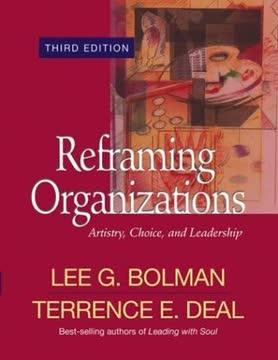
**Author:** Lee G. Bolman and Terrence E. Deal
**Estimated Reading Time:** 45 minutes
**What You'll Learn:**
- Why organizations are far more complex than they appear - The four frames that reveal how organizations actually work - How to diagnose problems using multiple perspectives - Why great leaders see what others miss - How to lead change that actually sticks
**Who This Book Is For:**
Managers, executives, and leaders who want to move beyond simplistic answers. Anyone who has ever felt confused by organizational politics, frustrated by resistance to change, or puzzled by why smart people make irrational decisions. This book is for those ready to see organizations with new eyes.
Most people walk into organizations every day without really seeing them. They notice the surface: the offices, the titles, the meetings, the memos. They assume that if the structure makes sense on paper, the organization should work. When things go wrong, they look for a simple cause. A bad hire. A broken process. A difficult personality. But organizations rarely fail for simple reasons. Consider a hospital that merges with another hospital. On paper, the merger makes sense. Combined resources, reduced costs, better care. The structural logic is sound. Yet within months, productivity drops. Doctors leave. Nurses complain. Patients report worse experiences. What happened? A structural analyst would point to unclear reporting lines and duplicated departments. A human resource specialist would see employees who feel devalued and anxious about their futures. A political observer would notice that two powerful groups are fighting over turf and resources. A symbolic thinker would recognize that two distinct cultures, each with its own rituals and heroes, are colliding. All four are right. None alone has the full picture. This is the central insight of Reframing Organizations: organizations are both more complex and more subtle than most of us realize. They cannot be understood through a single lens. They require multiple perspectives, each revealing a different dimension of reality. The problem is that most of us have a favorite lens. Engineers see structures. Psychologists see people. Political scientists see power struggles. Anthropologists see rituals and meaning. We become attached to our preferred way of seeing, and we miss what other perspectives would reveal. This is not just an intellectual limitation. It has practical consequences. Leaders who see only structure will reorganize endlessly while ignoring the human pain that undermines their efforts. Leaders who see only people will invest in training and development while ignoring the political battles that determine who actually gets resources. Leaders who see only power will treat every disagreement as a battle to be won, missing opportunities for genuine collaboration. The authors, Lee Bolman and Terrence Deal, spent decades studying organizations and…
Continue reading in the MinuteRead app
Get the complete 30-minute summary of Reframing Organizations
Get the complete summary in the appOrganizations are complex. No single perspective captures the full picture.
Use four frames: structural, human resource, political, and symbolic.
Structure should follow strategy. Clarify goals before designing roles.
People are motivated by meaning, growth, and recognition, not just money.
Power comes from multiple sources. Understand them and use them ethically.
Conflict is normal. Manage it productively.
"Reframing Organizations" is a strong fit if you want practical ideas around leadership, business, education, especially themes like organizations are complex. no single perspective captures the full picture; use four frames: structural, human resource, political, and symbolic. The MinuteRead summary distills these concepts into a focused read, whether you're deciding whether to buy the book or applying its lessons at work.
Lee G. Bolman is a renowned scholar and author in the field of leadership and organizational theory. He co-authored Reframing Organizations with Terrence E. Deal, which has become a seminal text in management education. Bolman's work focuses on providing practical frameworks for understanding and navigating complex organizational environments. His approach combines academic rigor with real-world applicability, making his insights valuable to both students and practitioners. Bolman's background i…
View all summaries by Lee G. BolmanContinue Reading
Access the complete 30-minute summary and thousands more nonfiction books in the MinuteRead app.

Continue reading the complete summary in the MinuteRead app.