MinuteRead
30 min
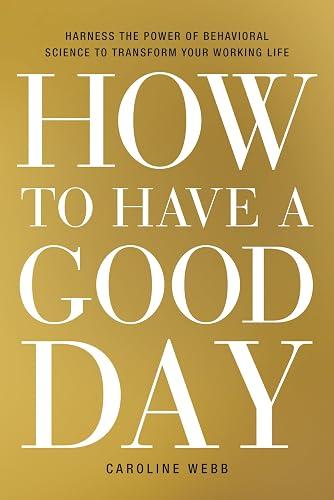
Book summary
by Caroline Webb
Premium summary · Opens in the app · 30 min read
Most of us begin the workday with a quiet hope that things will go well. We want to be productive. We want to have pleasant interactions. We want to feel satisfied when we close the laptop in the evening. Yet somewhere between the morning coffee and the afternoon meeting marathon, that hope often gets buried under an avalanche of emails, interruptions, difficult conversations, and unexpected problems.
**Author:** Caroline Webb
**Estimated Reading Time:** 45 minutes
**What You'll Learn:** How to apply insights from behavioral science, psychology, and neuroscience to transform ordinary workdays into consistently productive, satisfying, and successful experiences. You will discover how to set intentions, manage attention, make better decisions, build stronger relationships, communicate with influence, and sustain energy throughout the day.
**Who This Book Is For:** Professionals who feel overwhelmed by competing demands, leaders who want to bring out the best in their teams, and anyone who suspects that the quality of their days is determined less by circumstances than by how they approach them.
Most of us begin the workday with a quiet hope that things will go well. We want to be productive. We want to have pleasant interactions. We want to feel satisfied when we close the laptop in the evening. Yet somewhere between the morning coffee and the afternoon meeting marathon, that hope often gets buried under an avalanche of emails, interruptions, difficult conversations, and unexpected problems. The result is a familiar feeling: the day happened to us, rather than us shaping it. Caroline Webb wrote *How to Have a Good Day* to address a simple but profound question: Why do some people consistently manage to have productive, enjoyable days even in demanding jobs, while others with similar responsibilities feel perpetually frazzled and dissatisfied? Her answer draws on an unusual combination of expertise. Webb spent years as an economist at the Bank of England, then more than a decade as a partner at McKinsey & Company, where she advised senior executives on organizational performance. Along the way, she became fascinated by behavioral science: the field that studies how people actually make decisions, focus attention, manage emotions, and interact with others. What she discovered was that an enormous amount of scientific research existed on how the human brain works, but very little of it had been translated into practical guidance for everyday professional life. The research was scattered across academic journals in neuroscience, psychology, and behavioral economics. It was written in technical language. And it rarely addressed the specific challenges of a typical workday: the overflowing inbox, the back-to-back meetings, the difficult colleague, the high-stakes presentation. Webb's contribution was to bridge that gap. She synthesized decades of research into a practical framework that anyone can use to improve their daily experience of work. The book is organized around what she calls the "Good Day" approach: a set of strategies for managing your attention, your intentions, your energy, your relationships, and your decisions in ways that align with how your brain actually works. The central insight is both simple and liberating. Your experience of a day is not determined solely by what happens…
Continue reading in the MinuteRead app
Get the complete 30-minute summary of How to Have a Good Day
Get the complete summary in the appSet intentions at the start of each day to prime your brain to notice what matters.
Singletask. Focus on one thing at a time to boost productivity and quality.
Take strategic breaks every 90 minutes to maintain peak performance.
Prioritize by asking "What really matters most right now?" and focus on that.
Use the positive no to protect your time without damaging relationships.
Approach difficult people with the "good person, bad circumstances" mindset.
"How to Have a Good Day" is a strong fit if you want practical ideas around self help, psychology, business, especially themes like set intentions at the start of each day to prime your brain to notice what matters; singletask. focus on one thing at a time to boost productivity and quality. The MinuteRead summary distills these concepts into a focused read, whether you're deciding whether to buy the book or applying its lessons at work.
Motivated to help readers with we miss a big opportunity if we simply let the day happen to us, Caroline Webb wrote “How to Have a Good Day” to package those ideas for a fast, focused read. In “How to Have a Good Day”, Caroline Webb focuses on we miss a big opportunity if we simply let the day happen to us. Through “How to Have a Good Day”, Caroline Webb distills the core ideas on self help into lessons readers can absorb in a single short sitting. Readers turn to this work when they want Caroli…
Continue Reading
Access the complete 30-minute summary and thousands more nonfiction books in the MinuteRead app.

Continue reading the complete summary in the MinuteRead app.