 MinuteRead
30 min
Book summary
Premium summary · Opens in the app · 30 min read
Most advertising fails. It fails quietly, expensively, and repeatedly. Companies pour money into campaigns that look beautiful, win awards, and generate nothing. They hire creative teams who produce clever slogans that everyone remembers but no one acts on. They spend fortunes building brand awareness without ever knowing whether awareness leads to sales.
**Author:** Claude C. Hopkins
**Estimated Reading Time:** 45 minutes
**What You'll Learn:**
* Why advertising is a science governed by fixed principles, not a creative gamble * How to write copy that sells by treating every ad as a salesperson in print * The psychology behind why people buy and how to use it ethically * How to test campaigns cheaply before risking large investments * Why long copy often outperforms short copy when written correctly * How to build a brand personality that attracts customers instead of repelling them
**Who This Book Is For:**
This book is for business owners, marketers, copywriters, and anyone who spends money on advertising and wants to know whether that money is working. It is for people who suspect that most advertising is wasted but cannot articulate why. It is for those who want to replace guesswork with measurement, opinion with evidence, and hope with predictable results.
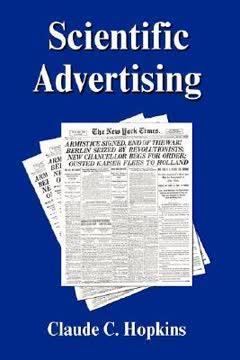
Most advertising fails. It fails quietly, expensively, and repeatedly. Companies pour money into campaigns that look beautiful, win awards, and generate nothing. They hire creative teams who produce clever slogans that everyone remembers but no one acts on. They spend fortunes building brand awareness without ever knowing whether awareness leads to sales. Claude Hopkins watched this happen for decades and decided it was unnecessary. He wrote Scientific Advertising in 1923, after a career spent selling everything from carpet sweepers to canned goods to automobiles. By the time he put his principles on paper, he had already proven them across hundreds of campaigns and millions of dollars in sales. His central claim was radical for its time and remains radical today: advertising is not an art form. It is a science. Hopkins did not mean that advertising lacks creativity. He meant that creativity must serve measurement. Every headline, every offer, every layout choice can be tested. The results can be tracked. What works can be repeated. What fails can be abandoned. The advertiser who understands this operates with the confidence of a chemist in a laboratory, not the anxiety of a gambler at a roulette table. The problem Hopkins identified is that most advertisers never test anything. They rely on intuition, tradition, or the loudest voice in the meeting room. They argue about what customers want instead of asking customers directly. They spend their entire budget on a single campaign and have no way to know whether it worked. When sales decline, they blame the product, the economy, or the sales team. They never consider that their advertising might be the problem. This book exists because that problem is solvable. Hopkins built his career on a simple insight: advertising is salesmanship in print. A good advertisement does exactly…
Continue reading in the MinuteRead app
Get the complete 30-minute summary of Scientific Advertising
Get the complete summary in the appAdvertising is salesmanship in print. Treat every ad as a salesperson and judge it by the sales it generates.
Test everything. Almost any question can be answered cheaply and definitively by a test campaign.
Focus on the customer, not the product. People care about what your product does for them, not what it is.
The headline is the most important element. It determines whether the rest of the ad is read.
Emotions drive decisions. Appeal to hope, desire, and aspiration, not just logic.
Long copy works when it is relevant. People read what interests them, regardless of length.
"Scientific Advertising" is a strong fit if you want practical ideas around business, writing, psychology, especially themes like advertising is salesmanship in print. treat every ad as a salesperson and judge it by the sales it generates; test everything. almost any question can be answered cheaply and definitively by a test campaign. The MinuteRead summary distills these concepts into a focused read, whether you're deciding whether to buy the book or applying its lessons at work.
Claude C. Hopkins (1866-1932) was a pioneering figure in advertising, known for developing scientific methods to measure and improve ad effectiveness. He introduced concepts like split testing, coupons for tracking, and emphasizing product benefits over features. Hopkins worked 16-hour days throughout his life, starting at age 9, and became wealthy but remained focused on his work. His practical approach and emphasis on results greatly influenced the advertising industry. Hopkins' methods, detai…
View all summaries by Claude C. HopkinsContinue Reading
Access the complete 30-minute summary and thousands more nonfiction books in the MinuteRead app.

Continue reading the complete summary in the MinuteRead app.






