MinuteRead
30 min
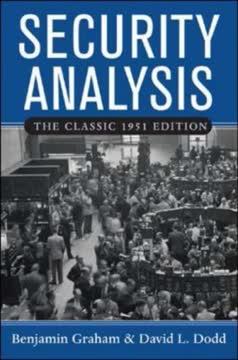
In the years following the 1929 stock market crash, the financial world lay in ruins. Fortunes that had seemed permanent evaporated in months. Banks failed by the thousands. Investors who had borrowed heavily to buy stocks found themselves owing more than their holdings were worth. The great bull market of the 1920s had promised prosperity for everyone, but it delivered something closer to financial devastation.
**Author:** Benjamin Graham
**Estimated Reading Time:** 45 minutes
**What You'll Learn:**
- Why markets frequently misprice securities and how to profit from those mistakes - How to analyze financial statements with a critical eye rather than accepting reported numbers - The essential role of margin of safety in protecting your capital - Why temperament matters more than intelligence in investing - How to distinguish between temporary setbacks and permanent decline - The practical framework for finding undervalued securities in any market
**Who This Book Is For:**
This book is for anyone who wants to understand the fundamental principles of intelligent investing. Whether you are a professional analyst, an individual investor managing your own portfolio, or simply someone who wants to think more clearly about financial decisions, the framework presented here will change how you approach markets. No advanced mathematics or specialized training is required. What is required is a willingness to think independently and the patience to let sound analysis guide your decisions rather than the emotions of the crowd.
In the years following the 1929 stock market crash, the financial world lay in ruins. Fortunes that had seemed permanent evaporated in months. Banks failed by the thousands. Investors who had borrowed heavily to buy stocks found themselves owing more than their holdings were worth. The great bull market of the 1920s had promised prosperity for everyone, but it delivered something closer to financial devastation. Benjamin Graham watched this unfold with a mixture of sorrow and professional fascination. As a young analyst on Wall Street, he had seen firsthand how the market's euphoria had blinded otherwise intelligent people to obvious risks. Companies with no earnings and no real assets traded at prices that implied decades of spectacular growth. Investment banks promoted securities they knew were weak because the fees were too tempting to refuse. Analysts made forecasts that had no basis in reality. And ordinary investors, trusting the experts, bought at the top and suffered the consequences. The experience convinced Graham that something fundamental was wrong with how securities were analyzed and valued. The problem was not simply that people made mistakes. Mistakes are inevitable in any human endeavor. The problem was that the entire system of security analysis had been built on a foundation of sand. Analysts were extrapolating recent trends into the indefinite future. They were treating stock prices as if they represented intrinsic value rather than the often-irrational opinions of the crowd. They were ignoring the balance sheet in favor of the income statement, forgetting that a company's assets provide a crucial cushion against hard times. Graham set out to create a more rigorous approach. Working with his colleague David Dodd at Columbia Business School, he began…
Continue reading in the MinuteRead app
Get the complete 30-minute summary of Security Analysis
Get the complete summary in the appPrice and value are different things. The difference is where opportunity lives.
The margin of safety is the central concept of investment. Never buy without it.
Markets are frequently irrational, driven by fear and greed rather than objective analysis.
Thorough analysis is essential. There are no shortcuts to identifying undervalued securities.
Temperament matters more than intelligence. The ability to remain calm under pressure is the key to success.
Financial statements must be read critically. Look beyond the headline numbers.
"Security Analysis" is a strong fit if you want practical ideas around finance, business, economics, especially themes like price and value are different things. the difference is where opportunity lives; the margin of safety is the central concept of investment. never buy without it. The MinuteRead summary distills these concepts into a focused read, whether you're deciding whether to buy the book or applying its lessons at work.
Benjamin Graham was a British-born American financial analyst, investor, and professor known as the "father of value investing." He authored two seminal texts: Security Analysis (1934) and The Intelligent Investor (1949). Graham's investment philosophy emphasized independent thinking, emotional detachment, and careful security analysis. He founded Graham-Newman Corp., a successful mutual fund, and taught at Columbia Business School and UCLA. Graham's ideas influenced many successful investors, i…
View all summaries by Benjamin GrahamContinue Reading
Access the complete 30-minute summary and thousands more nonfiction books in the MinuteRead app.

Continue reading the complete summary in the MinuteRead app.