MinuteRead
30 min
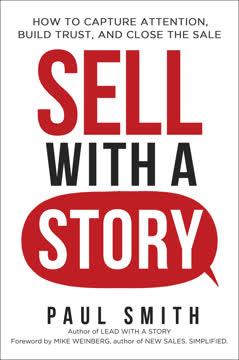
Book summary
by Paul Smith
Premium summary · Opens in the app · 30 min read
Every salesperson faces the same fundamental problem. Buyers have heard it all before. They have sat through countless presentations filled with bullet points, feature comparisons, and ROI calculations. They have learned to tune out the moment someone starts pitching. Their defenses go up, their attention wanders, and the message gets lost.
**Author:** Paul Smith
**Estimated Reading Time:** 45 minutes
**What You'll Learn:**
* Why stories are more persuasive than data alone * How to structure a compelling sales story from scratch * The 25 essential stories every salesperson should have ready * How to use stories at every stage of the sales process * How to find, refine, and deliver stories without sounding scripted
**Who This Book Is For:**
Sales professionals who want to move beyond feature lists and price negotiations. Business owners who need to communicate value memorably. Anyone who has ever struggled to make a message stick in a world drowning in information.
Every salesperson faces the same fundamental problem. Buyers have heard it all before. They have sat through countless presentations filled with bullet points, feature comparisons, and ROI calculations. They have learned to tune out the moment someone starts pitching. Their defenses go up, their attention wanders, and the message gets lost. This is not because buyers are unreasonable. It is because the human brain was never designed to process information the way most sales presentations deliver it. Facts and figures enter through the rational mind, but decisions emerge from somewhere much deeper. The most important choices people make are driven by emotion, then justified with logic afterward. Paul Smith spent years studying how the best salespeople in the world overcome this challenge. As the director of Consumer and Communications Research at Procter and Gamble, he had access to some of the most sophisticated sales organizations on the planet. He watched top performers close deals that seemed impossible. He saw average performers struggle with identical products and identical pricing. The difference was not the product. It was not the market. It was the way they communicated. The best salespeople told stories. Not anecdotes tossed in as an afterthought. Not jokes to break the ice. They told carefully crafted narratives that did the heavy lifting of persuasion. They used stories to introduce themselves, explain their products, handle objections, negotiate price, and close deals. They built entire sales conversations around the ancient human art of storytelling. This book is the result of Smith's research into what makes those stories work. He interviewed hundreds of salespeople across dozens of industries. He collected their best stories, analyzed their structure, and identified the patterns that separate effective sales stories from forgettable ones. What emerged is a practical system for using storytelling throughout the entire sales process. The problem this book addresses is simple. Most salespeople rely on facts, features, and logical arguments to persuade. But buyers make decisions emotionally first and rationally second. If you cannot reach the emotional part of the brain, you are fighting an uphill battle no matter how…
Continue reading in the MinuteRead app
Get the complete 30-minute summary of Sell with a Story
Get the complete summary in the appStories sell more effectively than facts alone because decisions are emotional first and rational second.
Every effective sales story has four parts: context, challenge, conflict, and resolution.
Make your customer the hero of your stories, not yourself.
Build a repertoire of twenty-five stories covering every stage of the sales process.
Find stories by keeping a journal, interviewing customers, and mining your organization's history.
Practice from key points, not memorized scripts, to sound natural and authentic.
"Sell with a Story" is a strong fit if you want practical ideas around business, communication, entrepreneurship, especially themes like stories sell more effectively than facts alone because decisions are emotional first and rational second; every effective sales story has four parts: context, challenge, conflict, and resolution. The MinuteRead summary distills these concepts into a focused read, whether you're deciding whether to buy the book or applying its lessons at work.
Paul Smith is a seasoned professional in leadership and communications. As the director of Consumer & Communications Research at Procter & Gamble, he brings extensive experience to his role. Smith is also a highly regarded trainer for P&G's management training colleges, specializing in leadership and communications. His expertise extends beyond his corporate role, as he is an accomplished author. Smith's previous work, "Lead with a Story: A Guide to Crafting Business Narratives that Captivate, C…
View all summaries by Paul SmithContinue Reading
Access the complete 30-minute summary and thousands more nonfiction books in the MinuteRead app.

Continue reading the complete summary in the MinuteRead app.