 MinuteRead
30 min
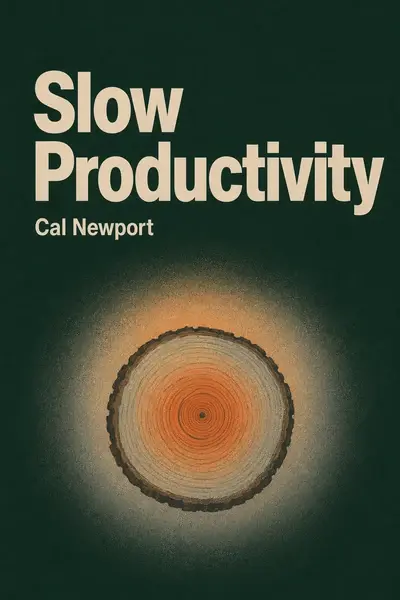
Book summary
by Cal Newport
Premium summary · Opens in the app · 5 min read
Slow Productivity offers a holistic new philosophy for a better relationship with work that allows us to make meaningful contributions at a sustainable pace, rooted in three pillars: fewer commitments, taking our time, and insisting on delivering high-quality work.
Slow Productivity offers a holistic new philosophy for a better relationship with work that allows us to make meaningful contributions at a sustainable pace, rooted in three pillars: fewer commitments, taking our time, and insisting on delivering high-quality work.
“Pseudo-productivity” is what Cal calls “the use of visible activity as the primary means of approximating actual productive effort.” Pair the dominance of knowledge work starting in the 90s with computers, the internet, and infinite communication tools, and you get a working population that’s busier talking about work than doing work.
That’s the corporate culture we live in today: It’s more important to look busy than to complete meaningful tasks. A study among 50,000 workers by RescueTime, for example, showed they check their email every 6 minutes on average.
So how can we get back to doing real, deep, rewarding and relevant work? Start by doing fewer things, Cal suggests. This is the first principle of Slow Productivity. “Strive to reduce your obligations to the point where you can easily imagine accomplishing them with time to spare. Leverage this reduced load to more fully embrace and advance the small number of projects that matter most.”
How can you do this? By limiting both the big and the small kinds of work in your life. Big work includes:
Missions, which are your big, ongoing goals. Projects, which are the milestones on the way to those goals. Daily goals, which is what you put on your to-do list on any given day.
Cal also presents 5 ideas on containing the smaller demands of work. Two of them are putting recurring tasks on autopilot and synchronizing with people in real-time. For example, you could set a fixed time slot to pay your bills and offer regular office hours for coworkers. The latter takes more time up front but reduces endless digital back-and-forth later.
Reduce your commitments, and your contribution to those commitments will drastically improve.
Lin-Manuel Miranda is a composer, actor, and playwright best-known for his 2 smash-hit musicals In the Heights and Hamilton. But Miranda first performed In the Heights in 2000, 8 years before it hit Broadway and he won a Tony Award. His secret? He gave his masterpiece time. He kept working on it on and off until it was ready for its success. This kind of slow-paced but relentless dedication was rare even before our distracted age, but nowadays it’s almost unheard of, Newport writes. It illustrates his second principle of Slow Productivity: Allow your work to progress at a natural pace. “Don’t rush your most important work. Allow it instead to unfold along a sustainable timeline, with variations in intensity, in settings conducive to brilliance.” Some actionable ways to…
Continue reading in the MinuteRead app
Get the complete 5-minute summary of Slow Productivity
Get the complete summary in the appLimit your obligations big and small so you have time to work on — and accomplish — the work that matters most.
Take your time with your biggest goals. They both need and deserve it.
Relentlessly insist on producing quality work until you succeed.
"Slow Productivity" is a strong fit if you want practical ideas around business, career, communication skills, especially themes like limit your obligations big and small so you have time to work on — and accomplish — the work that matters most; take your time with your biggest goals. they both need and deserve it. The MinuteRead summary distills these concepts into a focused read, whether you're deciding whether to buy the book or applying its lessons at work.
Motivated to help readers with slow Productivity offers a holistic new philosophy for a better relationship with work that allows us to make, Cal Newport wrote “Slow Productivity” to package those ideas for a fast, focused read. In “Slow Productivity”, Cal Newport focuses on slow Productivity offers a holistic new philosophy for a better relationship with work that allows us to make. Through “Slow Productivity”, Cal Newport distills the core ideas on business into lessons readers can absorb in a…
View all summaries by Cal NewportContinue Reading
Access the complete 5-minute summary and thousands more nonfiction books in the MinuteRead app.

Continue reading the complete summary in the MinuteRead app.






