MinuteRead
5 min
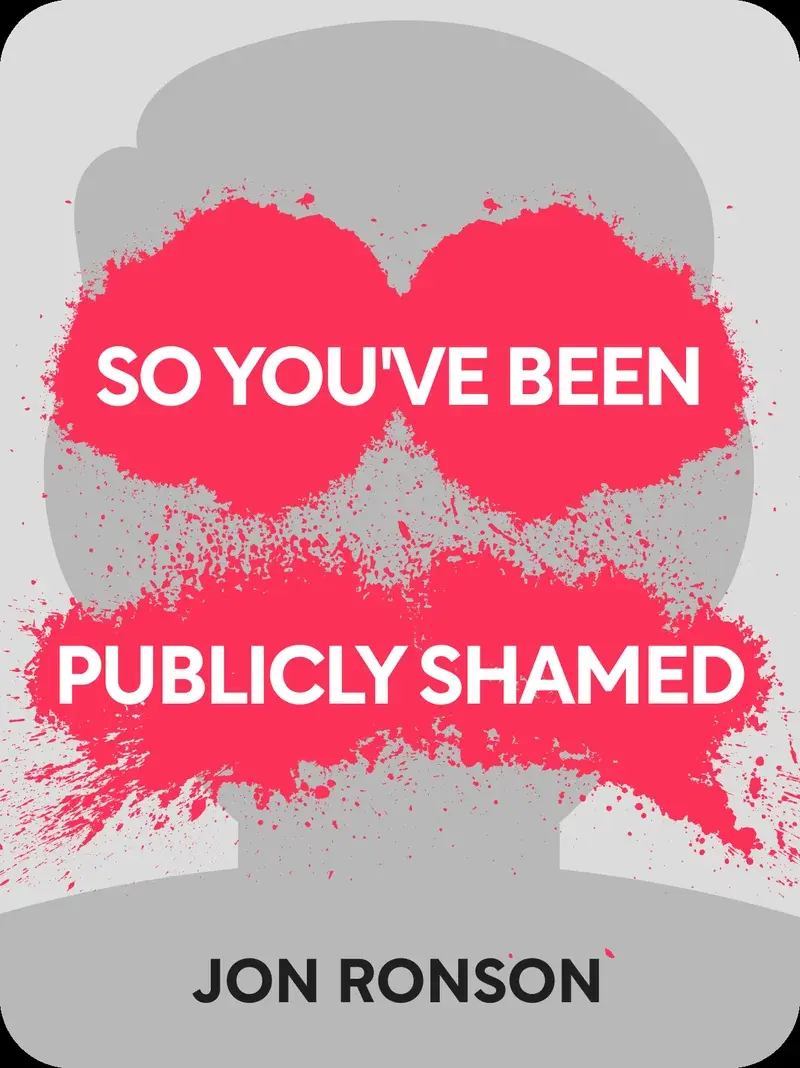
Book summary
by Jon Ronson
Premium summary · Opens in the app · 5 min read
So You’ve Been Publicly Shamed explains how public shaming can bring down websites, close businesses, destroy careers, and why it often suppresses ethical behavior instead of encouraging it.
So You’ve Been Publicly Shamed explains how public shaming can bring down websites, close businesses, destroy careers, and why it often suppresses ethical behavior instead of encouraging it.
Gentrification is forcing people out of areas where they loved spending quality time. Online public humiliation is an effort to reclaim some control. It’s a weapon of collective power.
There’s a policy in New York city called “Stop and Frisk.” This is a practice where police officers randomly stop and search as many as 1,800 people every day. It helps minimize petty crimes, such as graffiti and illegal drug use, but about 90% of people are innocent! Many find this treatment degrading and humiliating.
Authorities admit the tactic is a way to assert power in public spaces. They also see it as a way to secure the property for the “privileged” few, even at the expense of the majority.
Another example is the online message board 4chan. A popular meeting place for online trolls, 4chan users make it their business to participate in public online shaming initiatives. When asked about their motivation for these actions, many report that feelings of total disempowerment helped in fueling the behavior.
Have you ever considered how a riot or mob action is born? How can a handful of agitated people infect the entire mass with their passion? Curiously, once this spark of anger grows into a flame, it results in a fever pitch then escalates into a full-blown riot.
Nineteenth-century French physician Gustave Le Bon, who studied the social mechanisms of crowd activity, uses the metaphor of “contagion” to describe the collective public outrage. His word choice implies that rioting occurs unintentionally as individuals go with the flow of the group dynamic.
There appear to be clear patterns that drive crowd behavior. Without them, we’d be incapable of acting spontaneously together or even without a leader. It’s similar to the way a catchy chant-like, “Hell no, we won’t go!” might begin. A few people start out and then more chime in as well. Before you know it, you feel compelled to join in yourself.
Of course, not all group activity is like this chant. Often, people engage in group behavior because of their moral convictions. An example is someone who joins in the public shaming of a homophobe. Usually, it’s because they believe that homophobia is wrong, not because of the spellbinding force of the group dynamics.
There’s a case involving a young shoplifter who received an unusual but effective sentence for his crimes. He was to parade through the store he shoplifted from while wearing a sign that read, “I STOLE FROM THIS STORE. DON’T BE A THIEF OR THIS COULD BE YOU.” This humiliating…
Continue reading in the MinuteRead app
Get the complete 5-minute summary of So You’ve Been Publicly Shamed
Get the complete summary in the appMany people feel that others are taking their public space and they pushing them out of areas they once occupied.
In a crowd, even the most reserved and rational people can become impulsive and disorderly with little prompting.
We can use public shaming to our advantage to deter crime.
"So You’ve Been Publicly Shamed" is a strong fit if you want practical ideas around communication skills, book club, culture, especially themes like many people feel that others are taking their public space and they pushing them out of areas they once occupied; in a crowd, even the most reserved and rational people can become impulsive and disorderly with little prompting. The MinuteRead summary distills these concepts into a focused read, whether you're deciding whether to buy the book or applying its lessons at work.
Jon Ronson is an award-winning writer and documentary maker. He is the author of many bestselling books, including Frank: The True Story that Inspired the Movie, Lost at Sea: The Jon Ronson Mysteries, The Psychopath Test, The Men Who Stare at Goats and Them: Adventures with Extremists. His first fictional screenplay, Frank, co-written with Peter Straughan, starred Michael Fassbender. He lives in London and New York City.
View all summaries by Jon RonsonContinue Reading
Access the complete 5-minute summary and thousands more nonfiction books in the MinuteRead app.

Continue reading the complete summary in the MinuteRead app.