MinuteRead
5 min
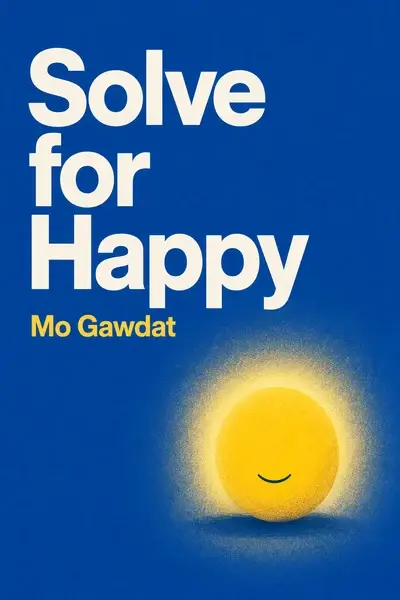
Solve For Happy lays out a former Google engineers formula for happiness, which shows you not only that it’s our default state, but also how to overcome the obstacles we face in remaining in it.
Solve For Happy lays out a former Google engineers formula for happiness, which shows you not only that it’s our default state, but also how to overcome the obstacles we face in remaining in it.
Every single person on earth has an inner monologue that runs 24/7/365. It’s a stream of thoughts that uses the I- or You-form when addressing us, for example “I should stop partying so much,” or “you can never be a professional at basketball.” The first big illusion Mo wants to help us shatter is the belief that this voice is not just talking to us, it is us.
In the 1930s, Russian psychologist Lev Vygotsky found out that the larynx, the part of our body that contains the vocal cords, occasionally shows the slightest of movements, even when we we’re not actually talking. He later built an entire theory around thinking and speech, indicating our inner monologue is nothing but an internalization of the external speech we use to talk to others. This means we’re not really talking to ourselves, our brain just happens to use the best tool it knows to talk to us.
Our minds process the outside world and then try to make sense of it as best as possible. But the resulting inner speech is just a flow of suggestions they make to help us decide what to do. That doesn’t mean you have to listen. You can question these ideas. Say no. Do something different.
If you strip away everything, what you own, your friends, your body, even your identity, the only thing that’s left is the invisible observer of the world. That’s the real you, and no one can take it away from you. If you expect nothing but to keep observing, life always exceeds your expectations.
Humans are built on heuristics. They’re little if-then rules for automatic behavior in certain situations. Shortcuts, if you will. For thousands of years, these heuristics have allowed us to survive, find food, and reproduce. However, over the past 2,000 years of somewhat modern civilization, they’ve become a lot less useful. In the modern world, little threatens to kill us, while much of what escapes us makes us unhappy. What used to ensure our survival now seems like a long list of errors standing in the way of us and happiness. Mo calls these errors blind spots, psychology refers to them as cognitive biases. There’s a long list of them in a variety of categories, but the first, and biggest, may be filters. Filters select what sensory information is passed on to your brain to process, because taking it all would be too much to handle. For example, while our eyes are very…
Continue reading in the MinuteRead app
Get the complete 5-minute summary of Solve For Happy
Get the complete summary in the appThe voice inside your head is not you.
Your brain’s automatic filters keep you from observing everything around you.
Living in the present always makes you happier, even if bad things happen.
"Solve For Happy" is a strong fit if you want practical ideas around happiness, mental health, personal development, especially themes like the voice inside your head is not you; your brain’s automatic filters keep you from observing everything around you. The MinuteRead summary distills these concepts into a focused read, whether you're deciding whether to buy the book or applying its lessons at work.
Mo Gawdat is the Chief Business Officer for Google [X], a serial entrepreneur and author of “Solve for Happy.” Mo has an impressive combined career of 27 years, starting at IBM Egypt as a Systems Engineer before moving to a sales role in the government sector. Venturing in to the UAE, Mo joined NCR Abu Dhabi to cover the non-finance sector. He then became acquainted with the consumer goods industry as Regional Manager of BAT. At Microsoft he assumed various roles over a span of seven and a half…
View all summaries by Mo GawdatContinue Reading
Access the complete 5-minute summary and thousands more nonfiction books in the MinuteRead app.

Continue reading the complete summary in the MinuteRead app.