MinuteRead
30 min
Book summary
by Neil Postman
Premium summary · Opens in the app · 5 min read
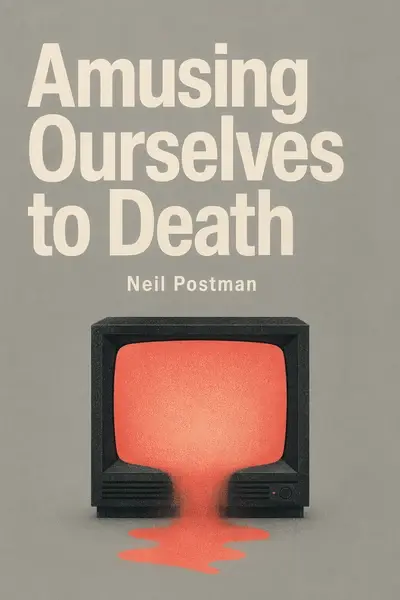
Amusing Ourselves To Death takes you through the history of media to highlight how entertainment’s standing in society has risen to the point where our addiction to it undermines our independent thinking.
Amusing Ourselves To Death takes you through the history of media to highlight how entertainment’s standing in society has risen to the point where our addiction to it undermines our independent thinking.
A few days ago, the 52nd Super Bowl glued over 100 million Americans to their TVs. That’s about a third of the entire population. Can you imagine a book being that popular? In recent history, only The Hunger Games comes close, with about 65 million copies sold. However, even if your book sells ‘just’ one million copies, it’s already part of the top 0.001%.
But not too long ago, things were different. Common Sense, Thomas Paine’s 49-page pamphlet that advocated for the US to seek independence from Great Britain, was printed 500,000 times – in 1776. That means one in five Americans read it. That’s because at the time, reading was both a way of entertainment and the arena of choice for public discourse.
Sure, politicians also gave hour-long speeches, but those were mostly supplemented with text and similar in structure and language. Also keep in mind: there were no photographs. Most people wouldn’t have recognized the president if he walked by, but his writing they’d be familiar with.
Given text was the only medium available to spread and gather information, this reading ‘trend’ would continue through most of the 19th century, especially with subscription and one-off models for newspapers making it affordable for the masses.
But then…
Around halfway through the 19th century, the telegraph really took off. This brilliant piece of technology allowed people to communicate short messages over vast distances in a matter of minutes. Sending letters back and forth took weeks, but with a telegram, important messages could reach the recipient immediately.
However, as humans are, they started using the telegraph not just when it was necessary, but all the time, simply because they could. Meaningless messages about royalties catching a cold and political rumors became standard. Similarly, film photography enabled taking pictures at scale in the late 1800s, so advertisements and newspapers made good use of the fact that “a picture is worth a thousand words.”
What both these media have in common is that they convey information in a way that completely lacks context. Think of them as the Twitter and Instagram of the time. So, when they took over public communication, the amount and frequency of information greatly increased, but the quality suffered.
People now knew more tidbits about everything, but much less about the few things that were important to understand in their entirety. That’s a problem and it persists to this day.
Continue reading in the MinuteRead app
Get the complete 5-minute summary of Amusing Ourselves To Death
Get the complete summary in the appLess than 200 years ago, everyone was well-read.
The telegraph and the camera ushered in a period of little context.
On TV, everything must be entertaining, so the medium dictates the message.
"Amusing Ourselves To Death" is a strong fit if you want practical ideas around culture, happiness, history, especially themes like less than 200 years ago, everyone was well-read; the telegraph and the camera ushered in a period of little context. The MinuteRead summary distills these concepts into a focused read, whether you're deciding whether to buy the book or applying its lessons at work.
Neil Postman was chairman of the department of communication arts at New York University. He passed away in 2003.
View all summaries by Neil PostmanContinue Reading
Access the complete 5-minute summary and thousands more nonfiction books in the MinuteRead app.

Continue reading the complete summary in the MinuteRead app.