 MinuteRead
30 min
Book summary
Premium summary · Opens in the app · 30 min read
Every year, thousands of companies gather their leadership teams in conference rooms to develop strategy. They analyze markets, debate opportunities, and craft ambitious plans. The output is almost always the same: a chart showing a modest dip followed by a dramatic upward curve. The famous hockey stick. Revenue will decline slightly as investments are made, then soar as the strategy takes hold.
**Author:** Chris Bradley, with Martin Hirt and Sven Smit
**Estimated Reading Time:** 45 minutes
**What You'll Learn:** Why most corporate strategies fail before they ever reach execution, how economic profit follows a power curve that most companies ignore, and the five specific moves that dramatically improve your odds of breaking into the top tier of performance.
**Who This Book Is For:** Executives frustrated by strategy processes that produce beautiful presentations but no meaningful change, leaders who suspect their planning cycles are designed to protect careers rather than create value, and anyone who wants to understand why some companies consistently outperform while most remain stuck in the middle.
Every year, thousands of companies gather their leadership teams in conference rooms to develop strategy. They analyze markets, debate opportunities, and craft ambitious plans. The output is almost always the same: a chart showing a modest dip followed by a dramatic upward curve. The famous hockey stick. Revenue will decline slightly as investments are made, then soar as the strategy takes hold. And then, almost without exception, nothing happens. The hockey stick never materializes. The strategy is quietly shelved. Next year, the same team gathers in the same room and produces the same chart with a new date. The cycle repeats. Why does this happen? The conventional answer is that execution failed. The strategy was sound, but implementation fell short. The team lacked discipline. The culture wasn't ready. The market shifted unexpectedly. Chris Bradley and his colleagues at McKinsey spent a decade investigating whether this explanation holds up. They analyzed thousands of companies, tracked their strategic plans against actual outcomes, and studied the social dynamics of strategy rooms. What they discovered was deeply uncomfortable for the business world. The problem isn't execution. The problem is that most strategies were never designed to succeed in the first place. They were designed to make people feel good. Strategy is supposed to be an intellectual exercise. You gather data, analyze options, and make rational choices about where to compete and how to win. But strategy happens in a social context. Real people with real careers sit around that table. They have bosses to impress, budgets to protect, and reputations to maintain. The strategy that emerges is often a negotiated settlement between competing personal interests, wrapped in the language of analysis. The result is predictable. Targets get sandbagged so they're easy to hit. Resources get spread evenly so no executive loses their power base. Long-term projections get inflated because nobody will be around to answer for them in five years. The hockey stick is a social artifact, not a strategic plan. Bradley's research reveals something even more striking. The gap between the best companies and everyone else…
Continue reading in the MinuteRead app
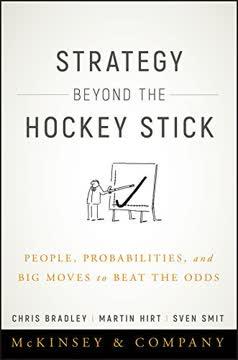
Get the complete 30-minute summary of Strategy Beyond the Hockey Stick
Get the complete summary in the appEconomic profit follows a Power Curve. The top quintile captures nearly 90 percent of all value. The middle gets almost
The social side of strategy consistently overwhelms the intellectual side. Sandbagging, hockey sticks, and peanut butter
Incremental improvement won't move you up the curve. The odds of moving from the middle to the top through small changes
Five big moves dramatically improve your odds: programmatic M&A, dynamic resource allocation, strong capital expenditure
Making three or more big moves increases your odds of reaching the top by six times.
The moves must be big relative to your industry. Small moves don't count.
"Strategy Beyond the Hockey Stick" is a strong fit if you want practical ideas around business, management, leadership, especially themes like economic profit follows a power curve. the top quintile captures nearly 90 percent of all value. the middle gets almost; the social side of strategy consistently overwhelms the intellectual side. sandbagging, hockey sticks, and peanut butter. The MinuteRead summary distills these concepts into a focused read, whether you're deciding whether to buy the book or applying its lessons at work.
Chris Bradley is a senior partner at McKinsey & Company and a leader in its Strategy Practice. He has over two decades of experience advising clients on corporate strategy across various industries. Chris Bradley co-authored "Strategy Beyond the Hockey Stick" with Martin Hirt and Sven Smit, drawing on McKinsey's extensive research and client work. Bradley is known for his expertise in strategic planning, resource allocation, and performance improvement. He frequently contributes to McKinsey publ…
View all summaries by Chris BradleyContinue Reading
Access the complete 30-minute summary and thousands more nonfiction books in the MinuteRead app.

Continue reading the complete summary in the MinuteRead app.






