 MinuteRead
30 min
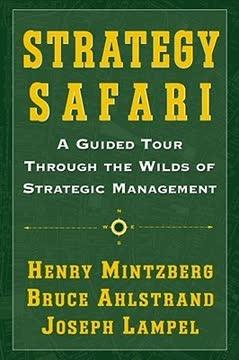
Imagine walking into a dark room with an elephant standing in the middle. You reach out and touch a leg. "It's a tree trunk," you announce. Another person touches the tail and insists it's a rope. Someone else grabs the trunk and swears it's a snake. Each person is right about the part they touched. Each person is completely wrong about the whole.
**Author:** Henry Mintzberg (with Bruce Ahlstrand and Joseph Lampel)
**Estimated Reading Time:** 45 minutes
**What You'll Learn:** Why there are ten fundamentally different ways to think about strategy, what each one reveals and misses, and how to combine them into a complete picture of how strategies actually form.
**Who This Book Is For:** Managers, executives, entrepreneurs, consultants, and students who want to move beyond simplistic formulas and understand the messy, human, and often surprising reality of strategic thinking.
Imagine walking into a dark room with an elephant standing in the middle. You reach out and touch a leg. "It's a tree trunk," you announce. Another person touches the tail and insists it's a rope. Someone else grabs the trunk and swears it's a snake. Each person is right about the part they touched. Each person is completely wrong about the whole. This ancient parable opens one of the most important books ever written about strategy. Henry Mintzberg, along with co-authors Bruce Ahlstrand and Joseph Lampel, argues that the field of strategic management has spent decades acting like those blind people. Consultants, academics, and executives have each grabbed hold of one piece of the strategy elephant and declared they understood the entire animal. The planning expert sees spreadsheets and timelines. The visionary founder sees a bold dream. The industry analyst sees competitive positioning. The organizational psychologist sees cognitive biases. The political observer sees coalitions and power struggles. Each perspective captures something real. None captures everything. The result has been a field at war with itself. Books promise the one true path to strategic success. Consulting firms sell proprietary frameworks as if they were universal laws. Business schools teach strategy as if it were a clean, rational process that happens in boardrooms. Meanwhile, actual strategy in actual organizations remains stubbornly messy, unpredictable, and human. Mintzberg's radical move was to stop arguing for one school and instead map the entire terrain. He identified ten distinct schools of thought, each with its own history, assumptions, strengths, and blind spots. Some are prescriptive, telling managers how strategy should be made. Others are descriptive, explaining how strategy actually emerges. The final school attempts to integrate them all. The book's central message is both humbling and liberating. Strategy is not a simple problem with a single solution. It is a complex, multifaceted phenomenon that requires multiple lenses to see clearly. The goal is not to pick the right school and ignore the others. The goal is to understand all ten well enough to know which lens to use when, and to recognize that the full picture only emerges when you combine perspectives. This matters because the stakes are enormous. Organizations fail not because they lack strategy but…
Continue reading in the MinuteRead app
Get the complete 30-minute summary of Strategy Safari
Get the complete summary in the appStrategy formation is like an elephant, and most people only touch one part. No single school of thought captures the wh
The ten schools fall into three groups: prescriptive (design, planning, positioning), descriptive (entrepreneurial, cogn
The design school emphasizes fit between internal capabilities and external opportunities, with the CEO as chief strateg
The planning school emphasizes formal process, but planning is not the same as strategy.
The positioning school emphasizes industry analysis and generic strategies, but analysis is not a substitute for judgmen
The entrepreneurial school emphasizes vision, but over-dependence on a single leader creates vulnerability.
"Strategy Safari" is a strong fit if you want practical ideas around business, management, business strategy, especially themes like strategy formation is like an elephant, and most people only touch one part. no single school of thought captures the wh; the ten schools fall into three groups: prescriptive (design, planning, positioning), descriptive (entrepreneurial, cogn. The MinuteRead summary distills these concepts into a focused read, whether you're deciding whether to buy the book or applying its lessons at work.
Henry Mintzberg is a renowned academic and author specializing in business and management. He has been teaching at McGill University since 1968 and has published extensively, with over 140 articles and 13 books. Mintzberg is known for his critical views on strategic planning and management education, as expressed in his books "The Rise and Fall of Strategic Planning" and "Managers Not MBAs". He advocates for a more practical approach to management education, focusing on experienced managers rath…
View all summaries by Henry MintzbergContinue Reading
Access the complete 30-minute summary and thousands more nonfiction books in the MinuteRead app.

Continue reading the complete summary in the MinuteRead app.






