MinuteRead
30 min
Book summary
by Janette Sadik-Khan
Premium summary · Opens in the app · 30 min read
For nearly a century, cities around the world have operated under an invisible assumption: streets exist to move cars. This belief is so deeply embedded in engineering manuals, planning codes, and professional training that most people never question it. They simply experience the consequences. Congested roads that never seem to improve. Intersections where crossing on foot feels like a gamble. Sidewalks squeezed between speeding traffic and blank walls. Neighborhoods carved apart by highways th
**Author:** Janette Sadik-Khan with Seth Solomonow
**Estimated Reading Time:** 45 minutes
**What You'll Learn:** How cities can transform their streets from car-dominated corridors into vibrant public spaces using low-cost, high-impact design changes. You'll understand the hidden rules that govern urban space, the political battles required to change them, and the data that proves people-focused streets work.
**Who This Book Is For:** Urban planners, city officials, transportation advocates, community organizers, and anyone who has ever looked at a dangerous intersection or underused street and wondered why it has to be that way.
For nearly a century, cities around the world have operated under an invisible assumption: streets exist to move cars. This belief is so deeply embedded in engineering manuals, planning codes, and professional training that most people never question it. They simply experience the consequences. Congested roads that never seem to improve. Intersections where crossing on foot feels like a gamble. Sidewalks squeezed between speeding traffic and blank walls. Neighborhoods carved apart by highways that were supposed to connect them. The result is a quiet crisis. Traffic crashes kill more than thirty thousand Americans every year, a toll comparable to a major war, yet these deaths rarely generate sustained outrage. They are treated as the unavoidable cost of modern life, tragic but inevitable. Meanwhile, the spaces between buildings, which should be the most valuable public assets a city possesses, have been surrendered to the narrow purpose of moving and storing private vehicles. Janette Sadik-Khan spent six years as New York City's transportation commissioner under Mayor Michael Bloomberg, from 2007 to 2013. During that time, she oversaw one of the most dramatic transformations of urban streets in modern history. Her team reclaimed acres of road space for pedestrians, built hundreds of miles of protected bike lanes, launched the largest bike-share system in North America, and created some of the city's most beloved public spaces. They did this not with massive budgets or decades-long construction projects, but with paint, planters, and a willingness to challenge decades of conventional wisdom. The central insight of her work is deceptively simple: the space needed to transform a city's streets already exists. It is hidden in plain sight, locked inside overbuilt roadways designed to highway standards for city conditions. By reading the street carefully, by understanding how design shapes behavior, and by acting quickly with low-cost materials, cities can reclaim this space for people. A twelve-foot traffic lane can become ten feet, freeing eight feet for a protected bike lane. A confusing triangular intersection can become a pocket plaza with a few planters and some chairs. A parking lane can become a bus lane that moves thousands of people per hour. This book is not a…
Continue reading in the MinuteRead app
Get the complete 30-minute summary of Streetfight
Get the complete summary in the appStreets have been designed for cars, not people, and this is a choice that can be changed.
The space needed for transformation already exists within the street itself.
Street design shapes behavior more powerfully than signs or enforcement.
Quick, low-cost interventions can demonstrate what is possible and build support for change.
Protected bike lanes attract riders who would never cycle in mixed traffic.
Bus rapid transit can achieve subway-like performance at a fraction of the cost.
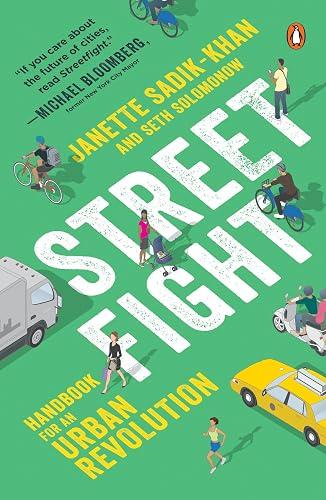
"Streetfight" is a strong fit if you want practical ideas around urban planning, urban, design, especially themes like streets have been designed for cars, not people, and this is a choice that can be changed; the space needed for transformation already exists within the street itself. The MinuteRead summary distills these concepts into a focused read, whether you're deciding whether to buy the book or applying its lessons at work.
Motivated to help readers with streets for the last century have been designed to keep traffic moving but not to support the life alongside, Janette Sadik-Khan wrote “Streetfight” to package those ideas for a fast, focused read. In “Streetfight”, Janette Sadik-Khan focuses on streets for the last century have been designed to keep traffic moving but not to support the life alongside. Through “Streetfight”, Janette Sadik-Khan distills the core ideas on urban planning into lessons readers can abso…
Continue Reading
Access the complete 30-minute summary and thousands more nonfiction books in the MinuteRead app.

Continue reading the complete summary in the MinuteRead app.