 MinuteRead
30 min
Book summary
Premium summary · Opens in the app · 30 min read
In 1990, Sears was the largest retailer in America. Its catalog reached half the homes in the country. Its stores anchored malls from coast to coast. Its brand was woven into the fabric of American life. By 2018, Sears had filed for bankruptcy.
**Author:** Richard Tanner Pascale
**Estimated Reading Time:** 45 minutes
**What You'll Learn:**
- Why organizations are living systems, not machines - How equilibrium becomes a silent killer of companies - What the "edge of chaos" really means and why it matters - How leaders can disturb systems rather than direct them - Why self-organization outperforms top-down control - How to harness failure as a competitive advantage - What separates companies that thrive from those that merely survive
**Who This Book Is For:**
Leaders who sense that traditional management approaches are failing. Managers frustrated by rigid hierarchies and slow decision-making. Entrepreneurs seeking to build adaptive organizations. Anyone who has watched once-great companies collapse and wondered why. And readers curious about how insights from biology, physics, and complexity science can transform how we think about work, change, and leadership.
In 1990, Sears was the largest retailer in America. Its catalog reached half the homes in the country. Its stores anchored malls from coast to coast. Its brand was woven into the fabric of American life. By 2018, Sears had filed for bankruptcy. What happened? The standard explanations point to e-commerce, to Amazon, to changing consumer habits. But those forces affected every retailer. Walmart survived. Target thrived. Sears collapsed. The difference was not access to information or lack of resources. Sears had data, capital, brand recognition, and distribution infrastructure that competitors would have envied. What Sears lacked was something harder to name: the capacity to adapt. Richard Pascale has spent decades studying why some organizations flourish while others, often larger and better resourced, fail. His conclusion, developed through research at Stanford, consulting work with Fortune 100 companies, and deep study of complexity science, is both simple and profound: organizations are living systems, not machines. This is not a metaphor. Pascale argues that the same principles governing ant colonies, immune systems, and ecosystems also govern human institutions. Companies do not merely resemble living systems. They are living systems, subject to the same laws of adaptation, equilibrium, and emergence that shape all complex adaptive systems. The implications are enormous. For a century, management theory treated organizations as machines to be engineered, controlled, and optimized. Leaders were mechanics. Strategy was a blueprint. Change was a project with a timeline and a budget. This mechanical worldview worked reasonably well in stable environments. It fails catastrophically in volatile ones. Consider the evidence. The average lifespan of a company in the S&P 500 has fallen from 61 years in 1958 to under 20 years today. The rate of CEO turnover has accelerated. The gap between the best and worst performers within industries has widened. Something fundamental has shifted in the business environment, and organizations built on mechanical assumptions are…
Continue reading in the MinuteRead app
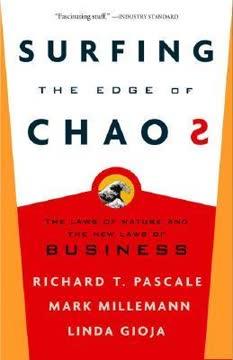
Get the complete 30-minute summary of Surfing the Edge of Chaos
Get the complete summary in the appOrganizations are living systems, not machines. The laws of living systems apply.
Equilibrium is dangerous. It leads to rigidity, complacency, and death.
The edge of chaos is where adaptation happens. Keep your organization there.
Self-organization outperforms top-down control. Create conditions for emergence.
Leaders disturb systems. They do not direct them.
Use amplifiers to accelerate change and dampers to stabilize.
"Surfing the Edge of Chaos" is a strong fit if you want practical ideas around business, leadership, management, especially themes like organizations are living systems, not machines. the laws of living systems apply; equilibrium is dangerous. it leads to rigidity, complacency, and death. The MinuteRead summary distills these concepts into a focused read, whether you're deciding whether to buy the book or applying its lessons at work.
Richard Pascale is a renowned business consultant, author, and lecturer with global recognition. He holds an Associate Fellowship at Oxford University and has consulted for numerous Fortune 100 companies. Pascale's reputation stems from his significant contribution to the 7S framework during his tenure at McKinsey & Company. His expertise spans business transformation, management practices, and organizational dynamics. As an accomplished author, Pascale's work often explores the intersection of …
View all summaries by Richard Tanner PascaleContinue Reading
Access the complete 30-minute summary and thousands more nonfiction books in the MinuteRead app.

Continue reading the complete summary in the MinuteRead app.






