 MinuteRead
30 min
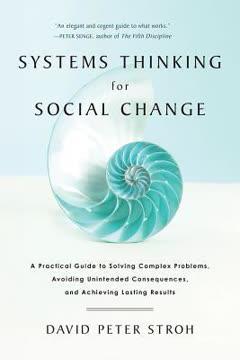
Book summary
Premium summary · Opens in the app · 30 min read
Every year, billions of dollars are spent on social programs. Dedicated professionals work long hours. Volunteers give their time. Foundations fund innovative initiatives. Governments pass new legislation. And yet, many of the problems these efforts target remain stubbornly resistant to change.
**Author:** David Peter Stroh **Estimated Reading Time:** 45 minutes
Why well-intentioned efforts to solve social problems often fail or make things worse. How to see the hidden dynamics that keep complex challenges stuck. What it takes to identify high-leverage interventions that create lasting change. How to build shared responsibility among stakeholders who currently blame each other. A practical framework for leading systemic change in communities and organizations.
This book is for leaders, changemakers, funders, policymakers, and community organizers who are frustrated by the gap between their efforts and their impact. It is for anyone who has worked hard to address homelessness, poverty, education gaps, criminal justice reform, or public health challenges, only to watch the problems persist or return. It is for people who suspect that the way they have been thinking about these problems is part of the problem itself.
Every year, billions of dollars are spent on social programs. Dedicated professionals work long hours. Volunteers give their time. Foundations fund innovative initiatives. Governments pass new legislation. And yet, many of the problems these efforts target remain stubbornly resistant to change. Homelessness persists despite decades of shelters and services. Educational achievement gaps remain despite reform after reform. Criminal recidivism stays high despite tougher sentencing and rehabilitation programs. Chronic disease rates climb despite public health campaigns. The list goes on. Why does this happen? Why do so many well-intentioned efforts produce disappointing results? Why do some interventions actually make problems worse? David Peter Stroh spent over thirty years wrestling with these questions. His answer is both simple and profound: we are trying to solve complex problems with the wrong kind of thinking. Most of us have been trained to think in straight lines. We see a problem, we identify a cause, we implement a solution, and we expect a result. This linear thinking works well for simple mechanical problems. If your car has a flat tire, you fix the tire. If you are hungry, you eat. If a pipe leaks, you patch it. But social problems do not behave like flat tires or leaky pipes. They are embedded in complex systems where multiple factors interact in non-obvious ways. Actions have delayed effects. Feedback loops amplify or dampen change. What looks like a solution today can become a problem tomorrow. The system pushes back against our interventions in ways we fail to anticipate. Consider food aid. When a famine strikes, the obvious response is to send food. And in the short term, this saves lives. But if food aid continues over time, it can depress local food prices, making it impossible for local farmers to compete. Farmers abandon their fields. Local agricultural capacity shrinks. The region becomes more dependent on aid,…
Continue reading in the MinuteRead app
Get the complete 30-minute summary of Systems Thinking For Social Change
Get the complete summary in the appSystems thinking reveals the hidden dynamics that keep complex problems stuck.
Good intentions are not enough; unintended consequences often undermine our efforts.
Shift from blame to shared responsibility to enable collaborative action.
Map the system before intervening to identify leverage points.
Changing goals and mental models is more powerful than changing parameters.
Use the four-stage process: build foundation, face reality, make choice, bridge gap.
"Systems Thinking For Social Change" is a strong fit if you want practical ideas around business, leadership, sociology, especially themes like systems thinking reveals the hidden dynamics that keep complex problems stuck; good intentions are not enough; unintended consequences often undermine our efforts. The MinuteRead summary distills these concepts into a focused read, whether you're deciding whether to buy the book or applying its lessons at work.
David Peter Stroh is an expert in systems thinking and organizational learning. He co-founded Innovation Associates, the consulting firm where Peter Senge developed his organizational learning concepts. Stroh has over 30 years of experience applying systems thinking to social change efforts. He's worked with various organizations and communities to address complex issues like homelessness, criminal justice reform, and education. Stroh is a faculty member at the Academy for Systems Change and has…
View all summaries by David Peter StrohContinue Reading
Access the complete 30-minute summary and thousands more nonfiction books in the MinuteRead app.

Continue reading the complete summary in the MinuteRead app.






